
Why I'm Bullish on Amazon 🛍️
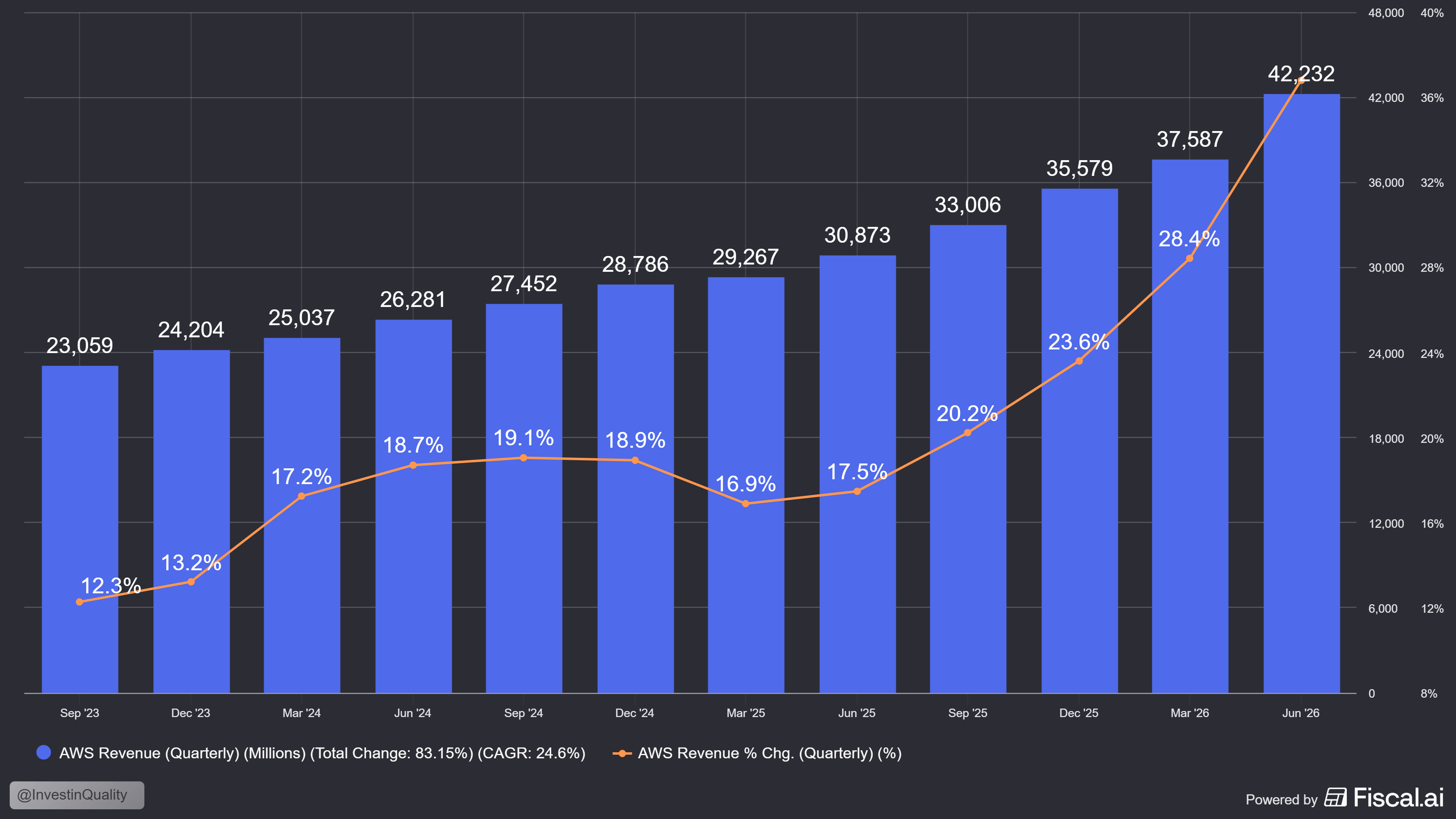
AWS Just Grew Faster Than It Has in 18 Quarters

Amazon Web Services is now a $169 billion annualized revenue business.
In Q2, it grew 36.7% year over year with an operating margin of 39.3%.
That is the fastest growth AWS has posted in 18 quarters, back when the business was less than half its current size.
The reacceleration of AWS is a work of art. It defies the ‘law of large numbers’:
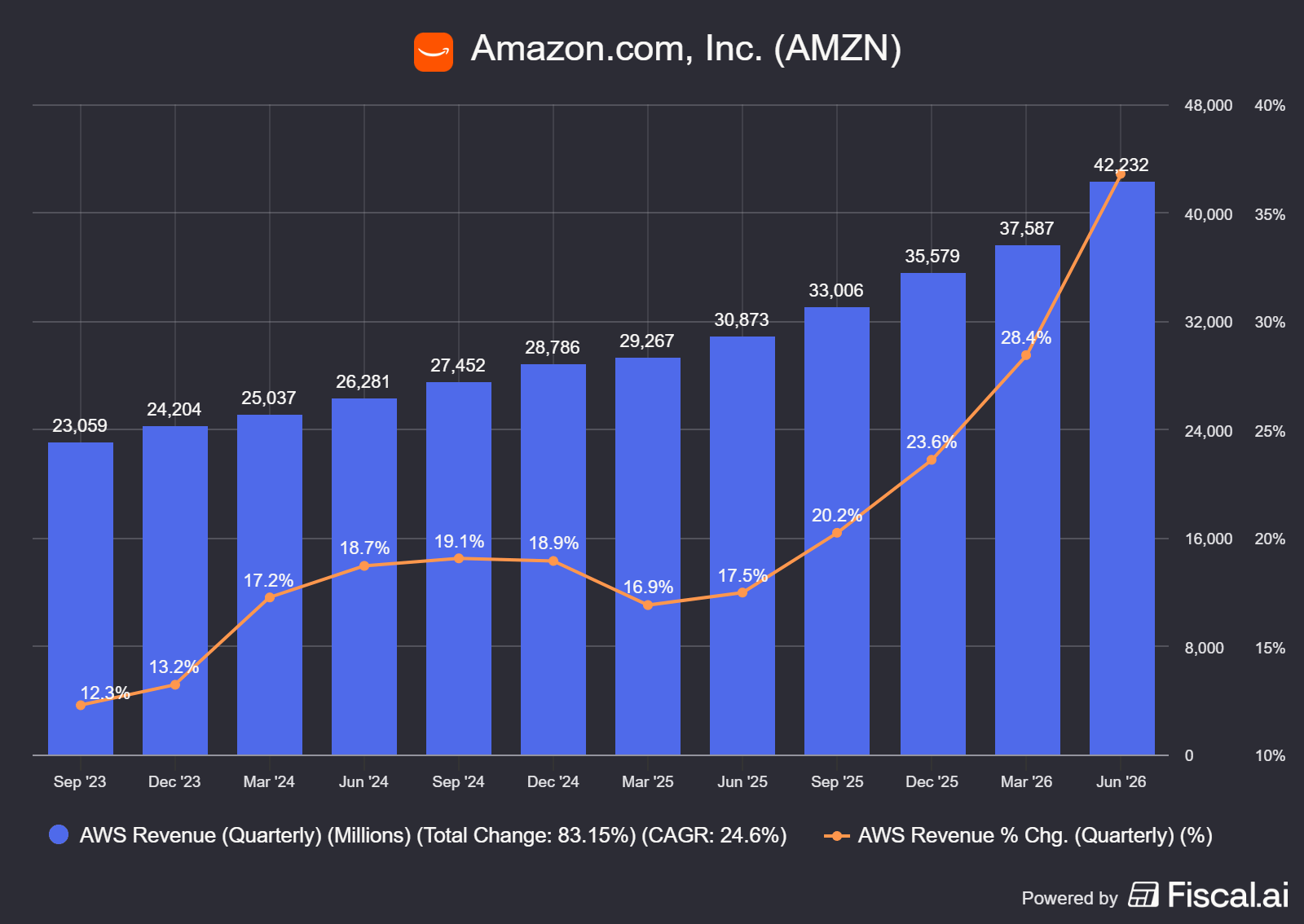
Growth rarely accelerates at this kind of scale.
Conventional economic theory says that as a business gets larger, its growth rate slows. Eventually, it slows down to the market average.
Bigger denominators make bigger percentage gains harder to repeat, every quarter, for every company that’s ever gotten large.
AWS just did the opposite for the fifth straight quarter in a row.
That is the main number in this report, and the reason why the market bid the stock up after hours.
Another very impressive number for Amazon’s size is the +20% YoY Net Sales growth.
It’s been a while since Amazon posted numbers like this - and it is supported by the incredible growth in AWS, ads, and Amazon’s chip business.
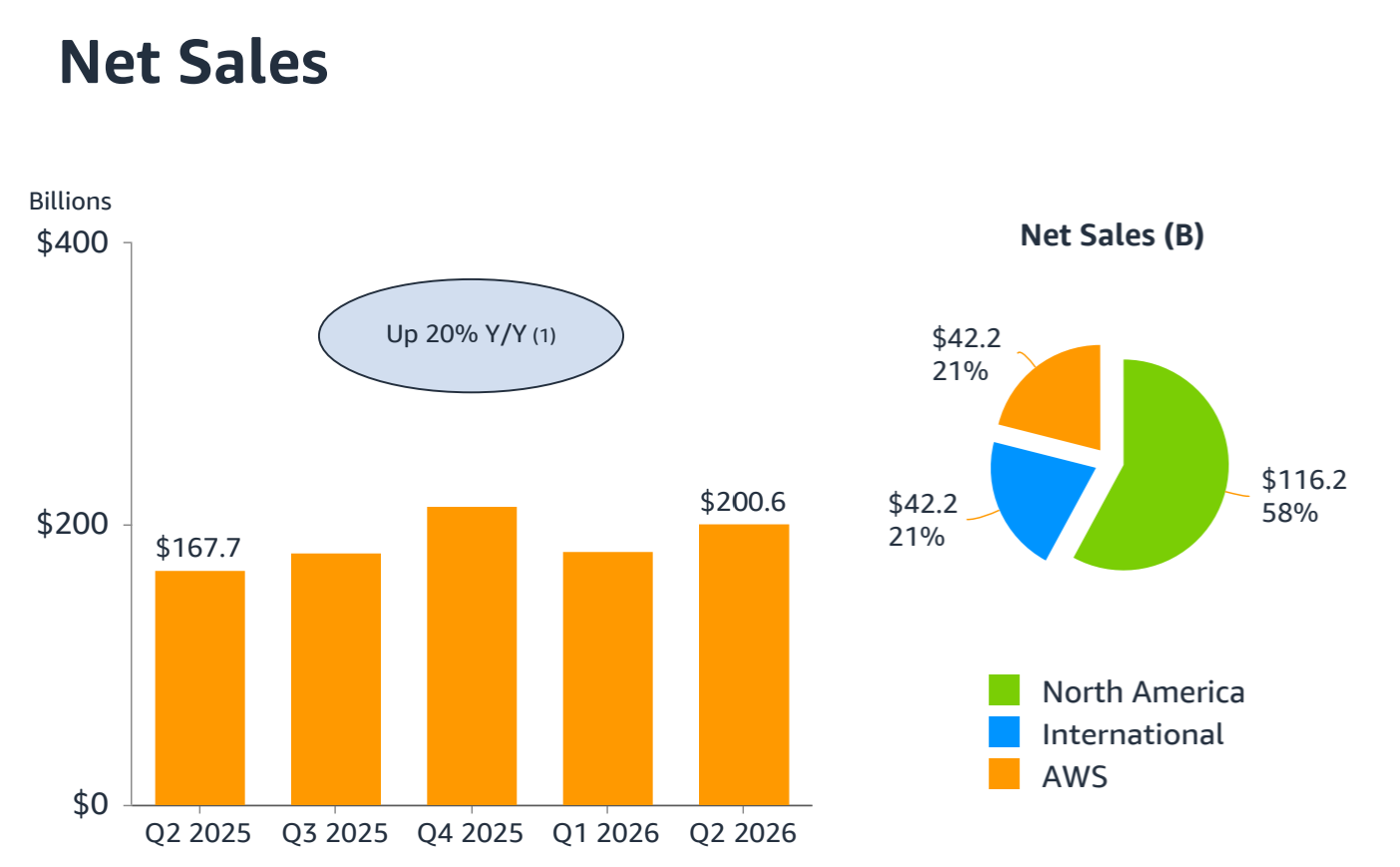
Why acceleration at this size is rare
Put $169 billion with a 39.3% operating margin in context.
If AWS were a standalone company, it would rank 24th on the Fortune 500.
It produces EBIT of ~$66 billion annually, growing at an unprecedented rate.
Businesses that size don’t usually speed up; they mature and slow down.
Management becomes defensive and wants to protect the business.
AWS skipped this chapter completely and added $4.6 billion QoQ, its largest sequential jump ever.
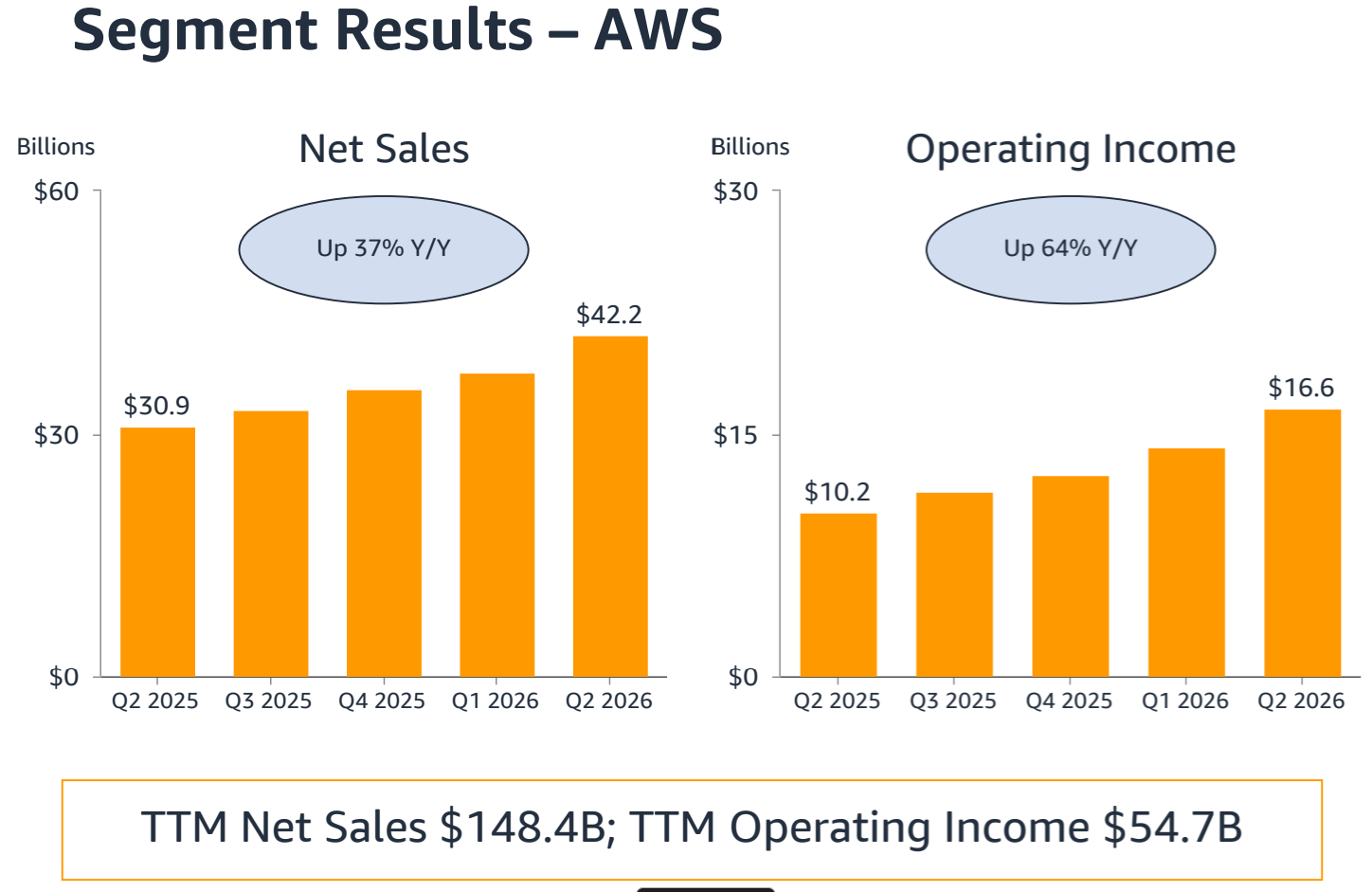
The backlog is exploding
AWS’ backlog is the second reason why the market loved this report.
A backlog of $496 billion, growing at a triple-digit rate year over year according to Andy Jassy:
“Our backlog stands at $496 billion, growing triple digits year-over-year”
Analysts on the call noted that this figure is now roughly 2.5 times its level in Q3 2025.
The backlog is forward-looking.
It’s what customers have already signed up for, not what management hopes happens next.
Revenue growth lags backlog growth, which means the acceleration we just saw isn’t the ceiling. It’s closer to a floor for what’s already locked in.
Two more data points back up the durability of the Amazon case:
Graviton, Amazon’s custom CPU chip, is used by 98% of AWS’s top 1,000 EC2 customers. This only increase the switching-cost moat of Amazon - which is under communicated.
Trainium and Graviton combined now generate over $25 billion in annualized revenue, growing at triple-digit rates. Anthropic and OpenAI, the two largest AI labs in the world, have both made multi-year, multi-gigawatt commitments to Trainium specifically.
When the two companies with the most compute-intensive, most demanding workloads on the planet commit multiple years of capacity to your chip, that is one hell of a signal.
Where the next leg of growth comes from
CEO Andy Jassy described AI demand right now as a barbell.
On one end, frontier AI labs are consuming enormous amounts of compute.
On the other, enterprises are getting real productivity gains from things like automated customer service and fraud detection.
The middle of that barbell, the bulk of existing enterprise production workloads, still isn’t using AI inference in a pervasive way.
Jassy expects that to be the largest segment eventually, by a wide margin. If he’s right, today’s acceleration is driven by the two thinner ends of the barbell, and the fat middle hasn’t shown up yet.
This is a multi-year growth argument for why growth rates can be sustainably high.
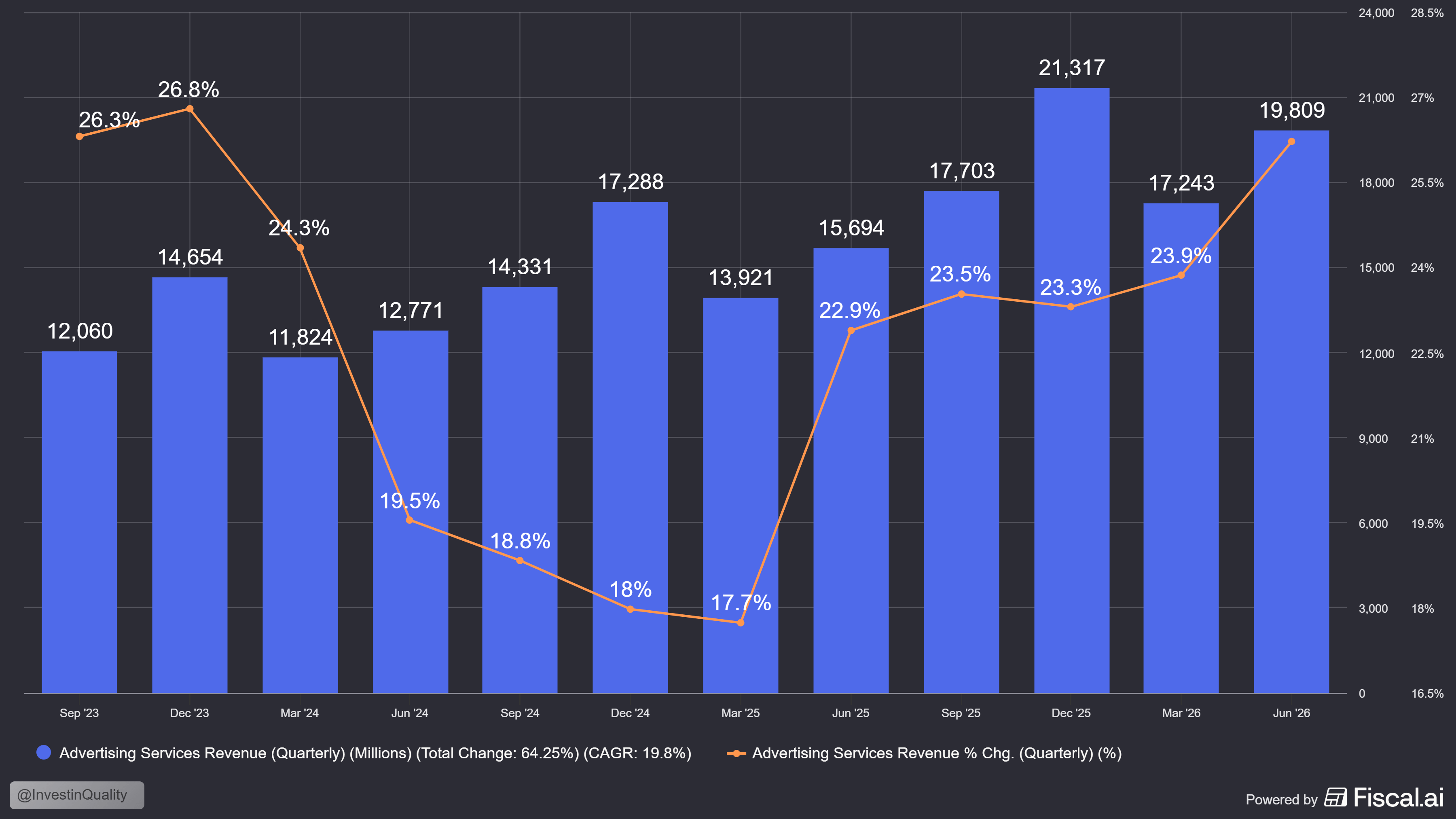
In addition, Amazon’s attractive ads business is also accelerating, having its best growth quarter since 2023 of 26.2% YoY growth:
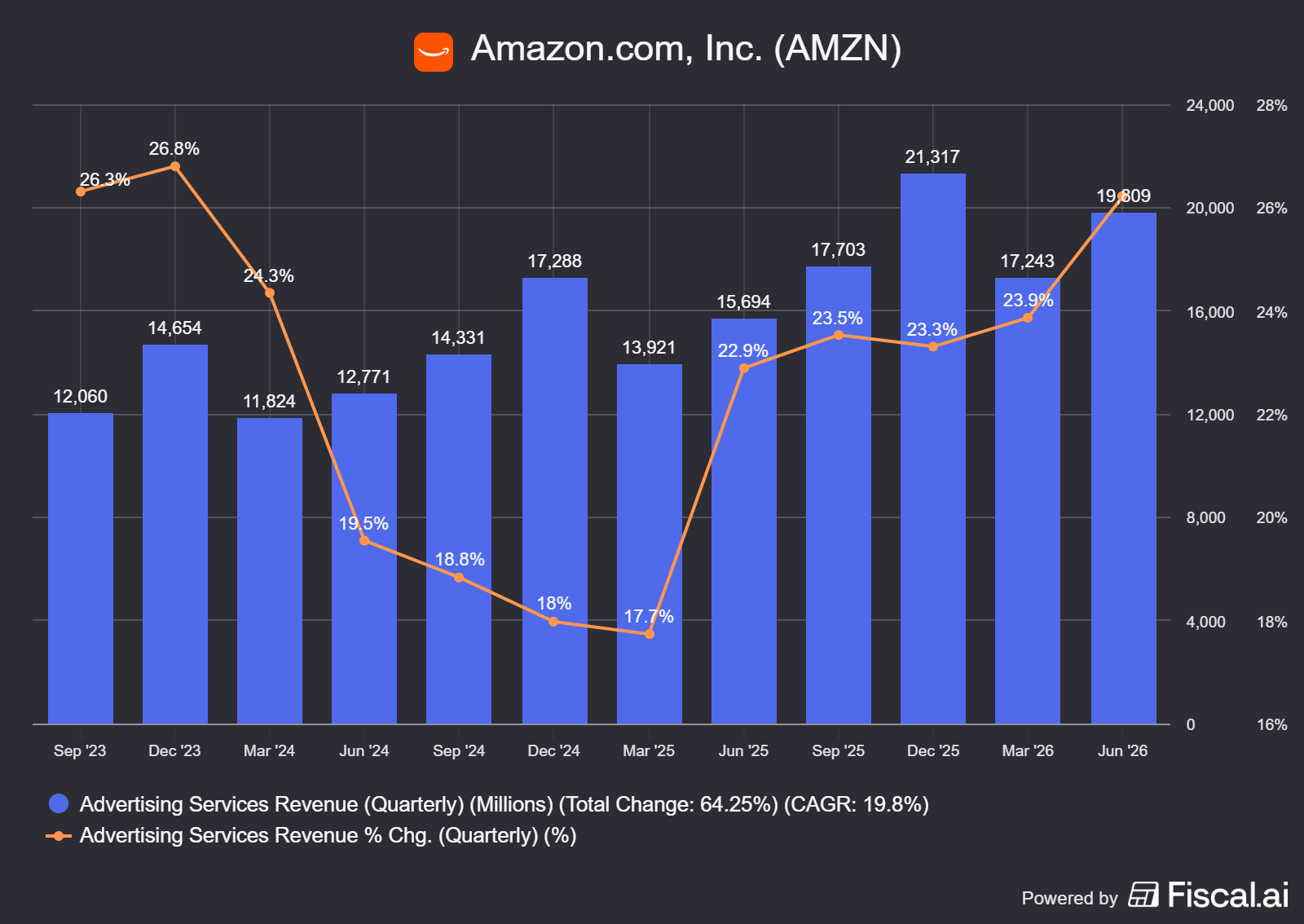
This is also a ‘business within the business’ - Amazon ads is estimated to have operating margins in the +50% range, closing in on ~$80 billion in annual revenue, this is a serious business, and one few ever talk about.
Now, about that free cash flow number
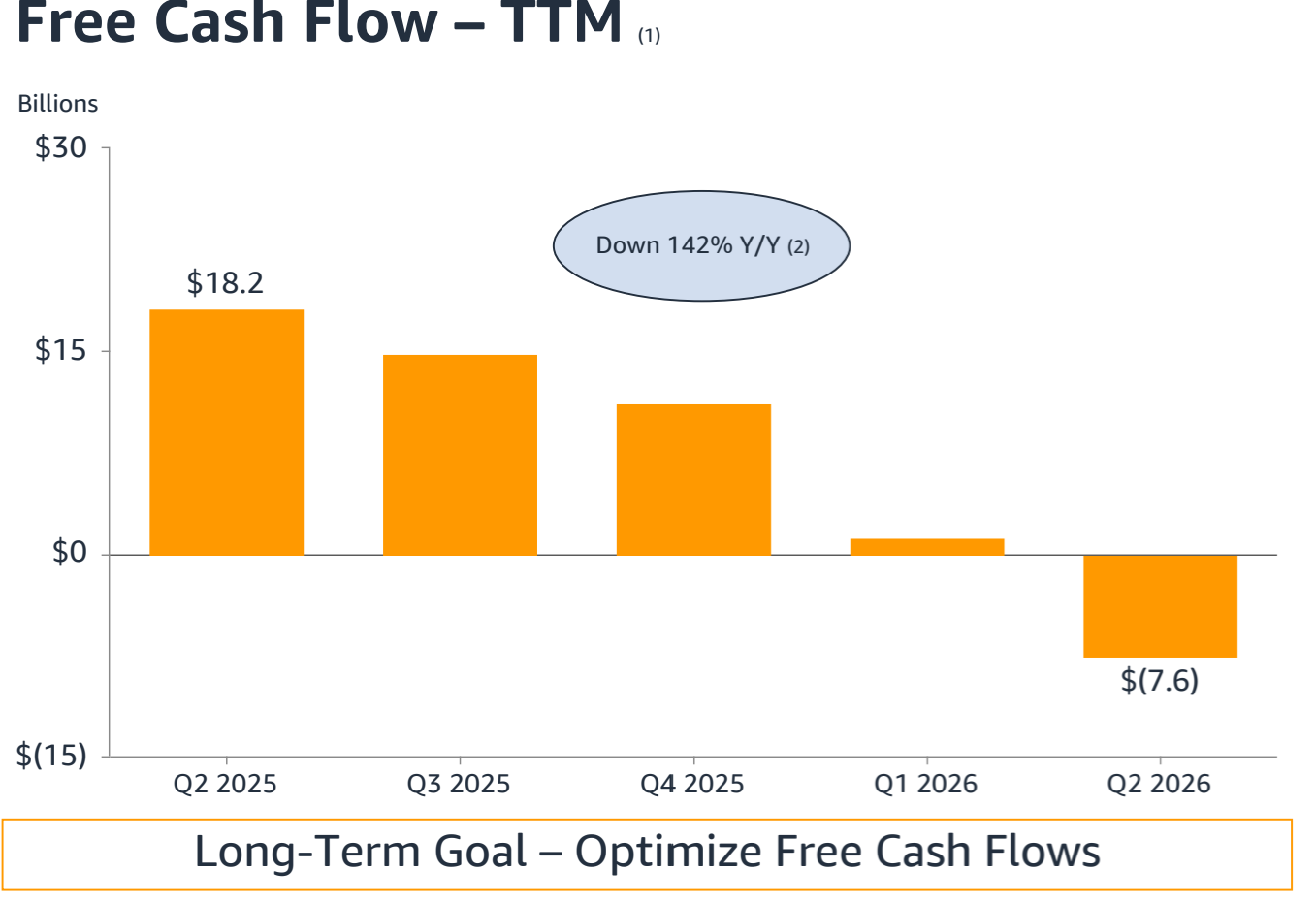
If you looked at the earnings report, you probably had a moment of concern about the free cash flows.
Trailing twelve-month free cash flow just went negative, at -$7.6 billion.
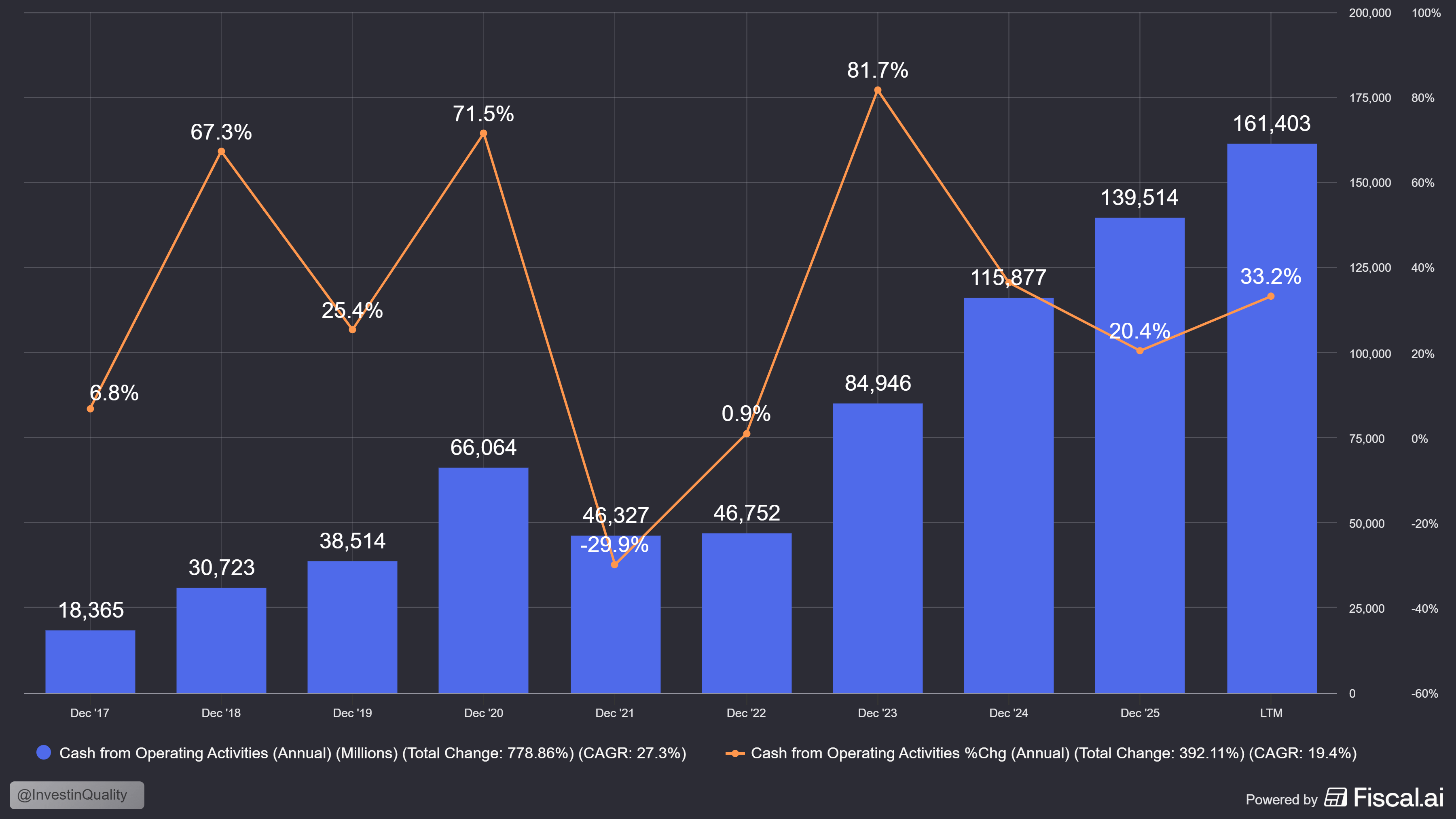
The key thing to note here is that ‘Operating cash flow’ actually rose +33% YoY.
So, the negative FCF is solely due to CapEx investments made very deliberately from the management team (And the investments are starting to bear fruits, which this quarter is proof of).
Let’s talk a bit more about CapEx - Amazon expects to spend approximately $220 billion in cash CapEx in 2026 (Up from $200 billion estimate earlier this year).
This is primarily driven by higher memory chip costs.
Here is the mechanic that matters the most, laid out by the management team on the call:
Data centers and servers run on completely different capital cycles.
Data center construction requires ~2 years of spending before a single server goes in and starts generating revenue. Once it’s built, that shell gets monetized for 30-plus years without ever repeating the upfront cost.
Servers and networking equipment are a shorter cycle: about 3 years to break even, with a useful life of five to six years, and Amazon has a track record of pulling those breakevens forward.
The negative free cash flow we’re seeing right now is the visible cost of building many data centers at the same time, before any of them are generating revenue yet. It is not a sign that AWS’s unit economics are deteriorating, the capital cycle has just not finished yet.
We’ve seen this pattern before from Amazon, and they have a track record of coming out of these heavy CapEx cycles a lot stronger than before.
The key is to watch the operating cash flows. Then watch whether or not CapEx goes back down as intended. If both of these things happen, free cash flows will explode in a few years.
Why I’m Bullish on Amazon in 3 charts
The pristine business within Amazon:
One of the fastest growing advertisement businesses globally:
Cash from operating activities booming, even if free cash flow is negative:
Final Thoughts
The positive far outweighs the negative this quarter for Amazon.
Free cash flow turned negative, yes. But we’re seeing proof of their heavy CapEx investments bearing fruits.
We’re also seeing a reacceleration of AWS, at an incredible scale.
And the advertising business booming.
I didn’t even go into the other business segments in this article, but let’s just say that they’re all doing pretty well right now.
The negative free cash flow is the temporary cost of building capacity for demand that is already contracted.
This quarter, Amazon blew it out of the park, and the best thing about it, was that it gave us evidence of future demand (with a massive backlog).
That’s all for today!
Ready to take the next step? Here’s how I can help you grow your investing journey:
Go Premium — Unlock exclusive content and follow our market-beating Quality Growth portfolio. Learn more here.
Essentials of Quality Growth — Join over 300 investors who have built winning portfolios with this step-by-step guide to identifying top-quality compounders. Get the guide.
Free Valuation Cheat Sheet — Discover a simple, reliable way to value businesses and set your margin of safety. Download now.
Free Guide: How to Identify a Compounder — Learn the key traits of companies worth holding for the long term. Access it here.
Free Guide: How to Analyze Financial Statements — Master reading balance sheets, income statements, and cash flows. Start learning.
Get Featured — Promote yourself to over 24,000 active stock market investors with a 42% open rate. Reach out: investinassets20@gmail.com