
SaaS-Stocks that Thrive in the Age of AI🚀
AI is disruption software, some business will die, and some will thrive

Hi there investor 👋
Every software company that mentions “AI agents” on an earnings call gets sold off.
It doesn’t matter if the mention is a warning or a victory lap.
The market has decided that AI is coming for SaaS, and it’s pricing the entire sector with a shotgun instead of a scalpel.
The IGV 0.00%↑ ETF that track tech-software (Not just SaaS), is down 21.61% from its 2025 highs, and was down as much as -40% in April.
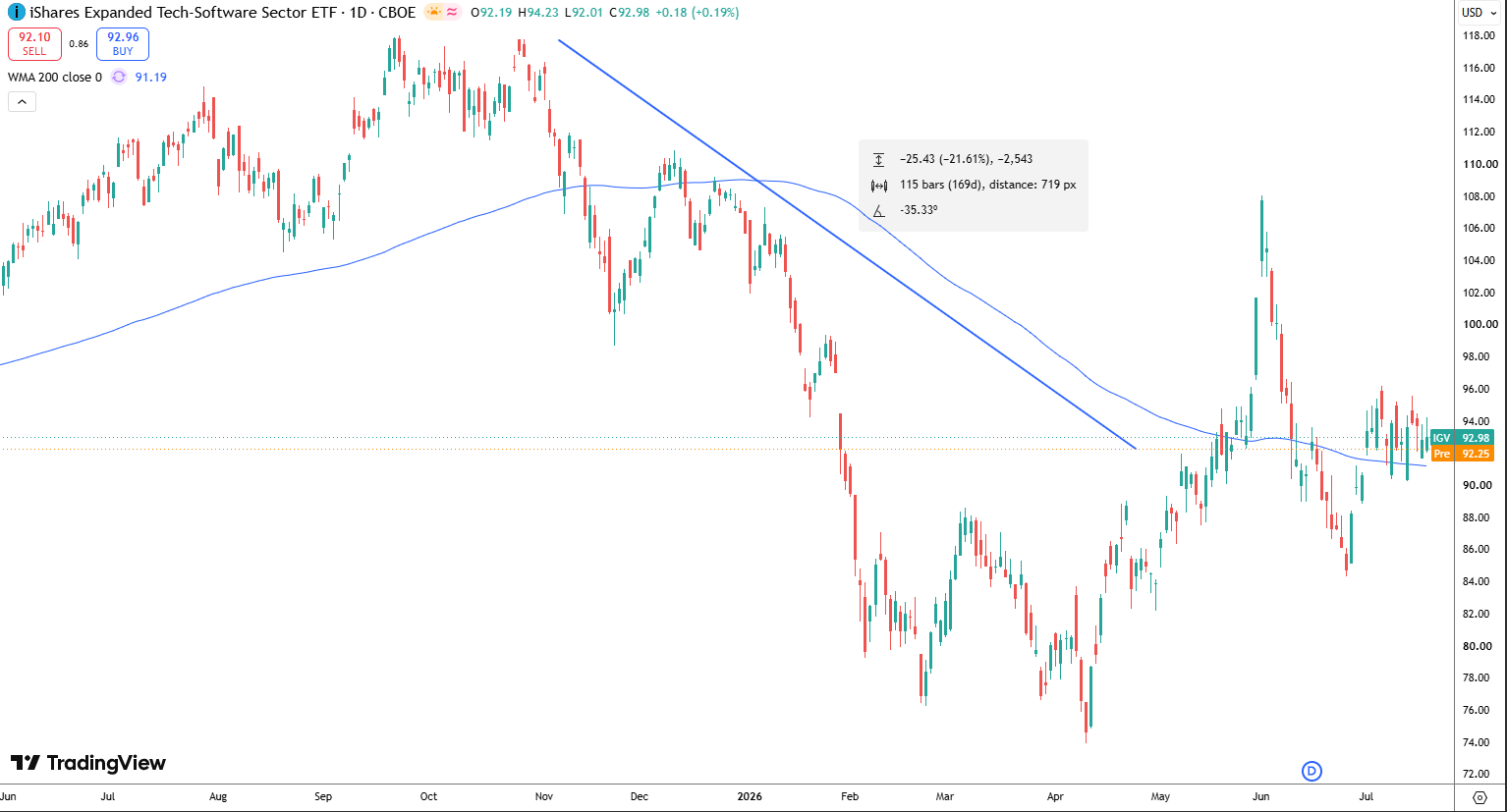
AI is clearly disruptive to the industry - but what companies carry the actual risk?
Some of the names getting punished have a real, structural problem.
Others are being dragged down by a narrative that has nothing to do with their actual business.
And a handful are becoming stronger because of AI while trading like they’re becoming weaker.
That gap, between the story and the numbers, is where the opportunity lives.
The four questions that actually matter
Here’s a repeatable way to sort any software company by real AI exposure.
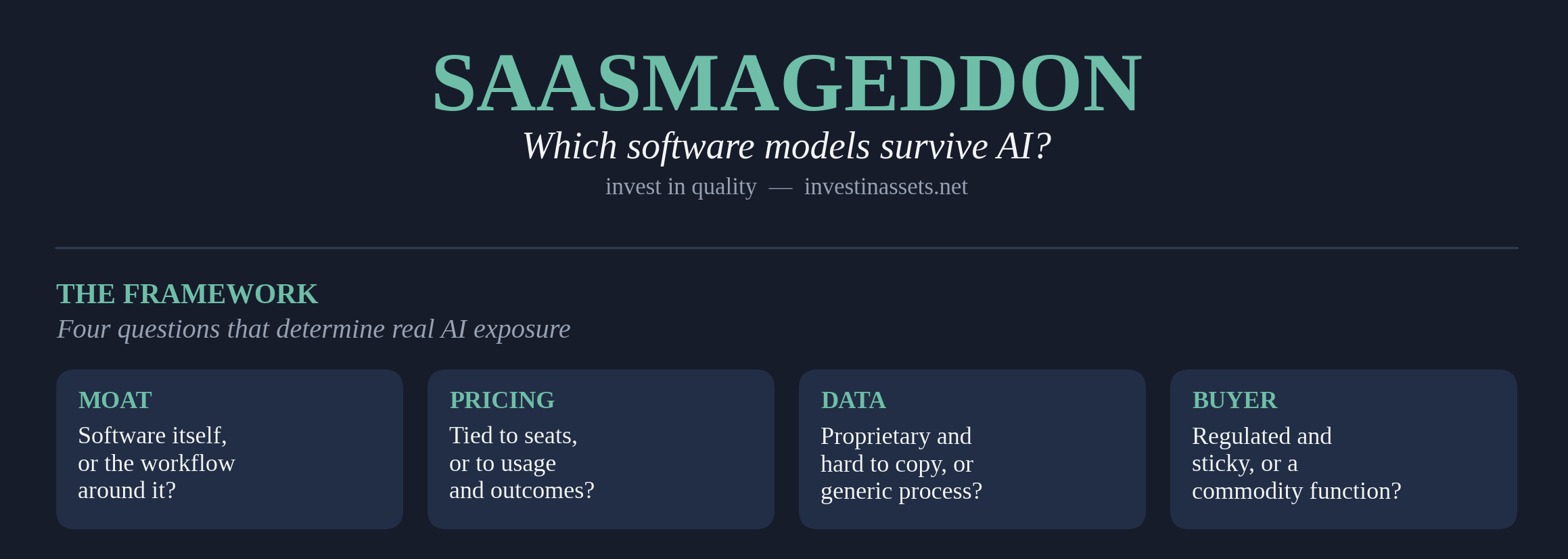
Is the moat the software, or the workflow around it? A thin layer sitting on top of a general-purpose model can be rebuilt by that model’s next version. A deep integration into a regulated process, a proprietary dataset, or a switching-cost-heavy workflow can’t.
Is pricing tied to headcount or to outcomes? Seat-based pricing is a direct bet that companies keep hiring the same number of people to do the same job. AI is explicitly designed to break that bet. Consumption-based or outcome-based pricing usually grows as AI usage grows, instead of shrinking.
Is there proprietary data AI can’t replicate? A company sitting on decades of validated, regulated, or otherwise hard-to-recreate data has something a generic model can’t just absorb. A company whose “data” is really just organized public information does not.
Is the buyer risk-averse and regulated, or a commodity back-office function? Compliance-heavy buyers move slowly and hate switching vendors. Commodity functions get automated first, because there’s no regulatory or safety reason not to.
Run any SaaS stock through those four questions and you get a much clearer picture than “AI is bad for software.”
Bucket 1: Companies at Risk
The ones getting hit hard
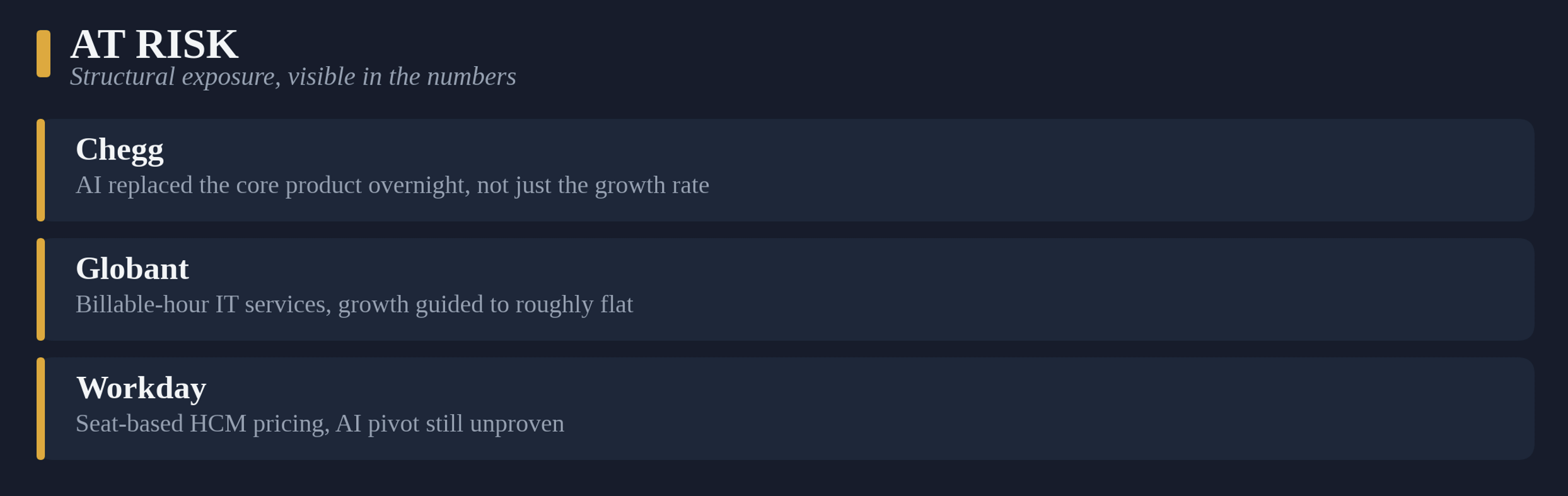
Chegg: the cautionary tale that already happened
Chegg is the clearest case study of AI disruption that exists, because it’s no longer a debate, it’s a finished story. The stock fell 48% in a single day back in May 2023, when then-CEO Dan Rosensweig told analysts ChatGPT was hurting new customer growth. That was the first time a public company admitted, on the record, that a generative AI tool was actively damaging its business.
![Chegg's Downfall Since ChatGPT [OC] : r/dataisbeautiful](https://substackcdn.com/image/fetch/$s_!J-qY!,f_auto,q_auto:good,fl_progressive:steep/https%3A%2F%2Fsubstack-post-media.s3.amazonaws.com%2Fpublic%2Fimages%2F3280f3f9-ba6c-41c6-9063-d4c6cb2cef74_1170x1460.jpeg "Chegg's Downfall Since ChatGPT [OC] : r/dataisbeautiful")
It didn’t stop there. Chegg has lost over 500,000 subscribers since ChatGPT launched. Its Q1 2026 revenue fell 48% year over year to $63.3 million, with the core Academic Services segment down 57%. The company has laid off well over half its workforce across four rounds since mid-2024, and the stock has traded as low as roughly $1, down about 99% from its 2021 peak of over $113.
Run it through the framework: the moat was a searchable database of solved homework problems, exactly the kind of content a language model reproduces instantly and for free. Pricing was a flat monthly subscription with zero switching costs. There was no regulatory moat, no proprietary workflow, nothing standing between Chegg and a free alternative that got dramatically better overnight. This is what it looks like when every box in the framework is checked in the wrong direction.
Globant, and the IT-services squeeze
Globant is a harder case, because the company is executing reasonably well and the stock has still been destroyed. Shares are down roughly 60% over the past year on growing concern that AI will “disintermediate” custom software development.
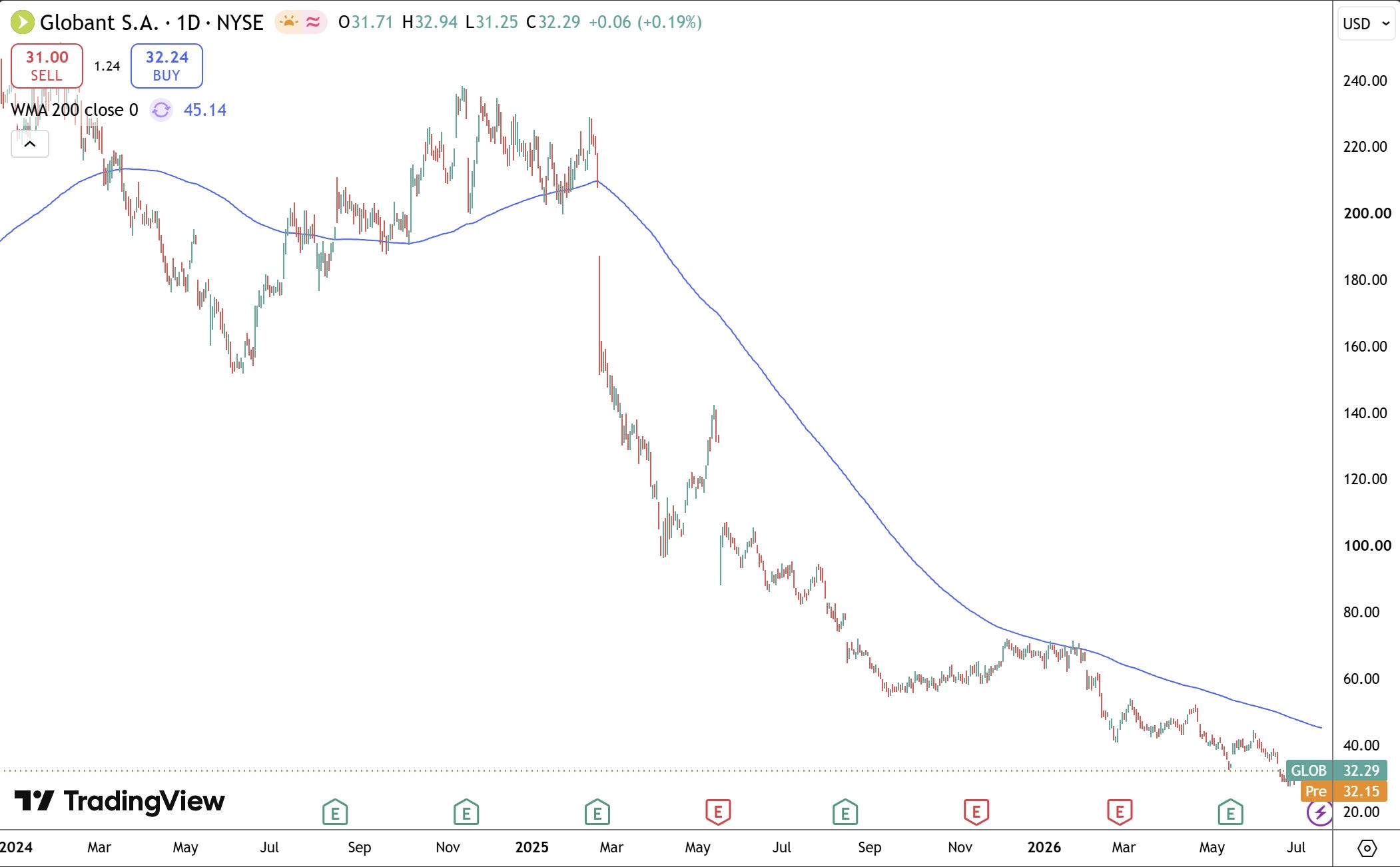
Full-year 2026 revenue guidance implies growth of just 0.3% to 2.2%, essentially flat, for a company that used to compound at a much faster clip.
Management’s response has been to lean into “AI Pods,” teams that pair engineers with AI tooling, and to keep buying back stock.
Q1 2026 results actually beat guidance. But the market isn’t rewarding execution here, it’s repricing the entire IT-services model, because the mechanism is real: when an AI coding assistant does the work of several junior developers, the billable-hour model that funded this industry for two decades gets structurally smaller.
EPAM, Globant’s closest peer, tells a similar story: 2026 growth guidance was cut to 4-6.5%, and by at least one analysis its return on invested capital has fallen below its cost of capital in recent years, a sign of a business that’s having to fight harder for the same returns.
Neither company is going to zero. But the framework points to real structural pressure here, not a sentiment overreaction: seat-and-hour-based pricing, a commodifiable service (routine coding and QA work), and a buyer (enterprise IT budgets) that is actively looking for ways to spend less on exactly this.
Workday: caught in the middle, and still needing to prove it
Workday sits closer to the boundary. The stock is down 53.6% from its all time highs, triggered by conservative fiscal 2027 subscription guidance of 12-13% growth that fell short of consensus.
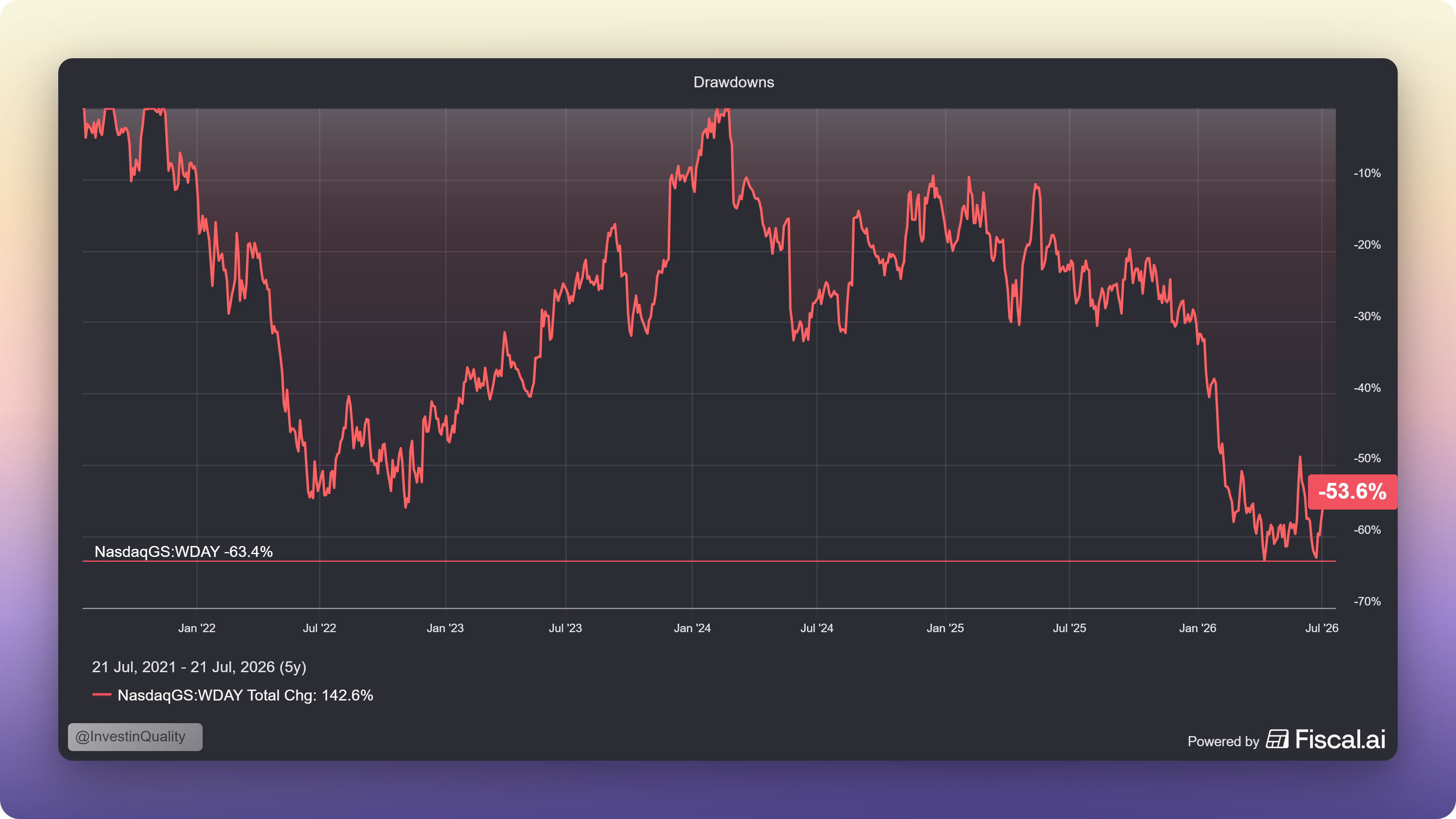
The mechanism is straightforward: Workday prices Human Capital Management (HCM) and payroll software per employee seat, and if AI reduces corporate headcount, the number of seats a company needs shrinks with it.
To be fair to Workday, its retention numbers are excellent: it serves roughly 65% of the Fortune 500 with a 97% gross retention rate, and displacement risk is low. But the seat-based pricing exposure is real, and unlike Salesforce below, Workday hasn’t yet shown hard evidence that its new consumption-based “Flex Credits” pricing is offsetting the risk. This is a name where the jury is still out, and the honest answer is that it belongs on a watchlist, not yet in a “buy the dip” pile.
5 More SaaS companies at risk:
HubSpot
DocuSign
Fiverr
Cognizant
Concentrix
Bucket 2: Insulated Companies
Built to survive
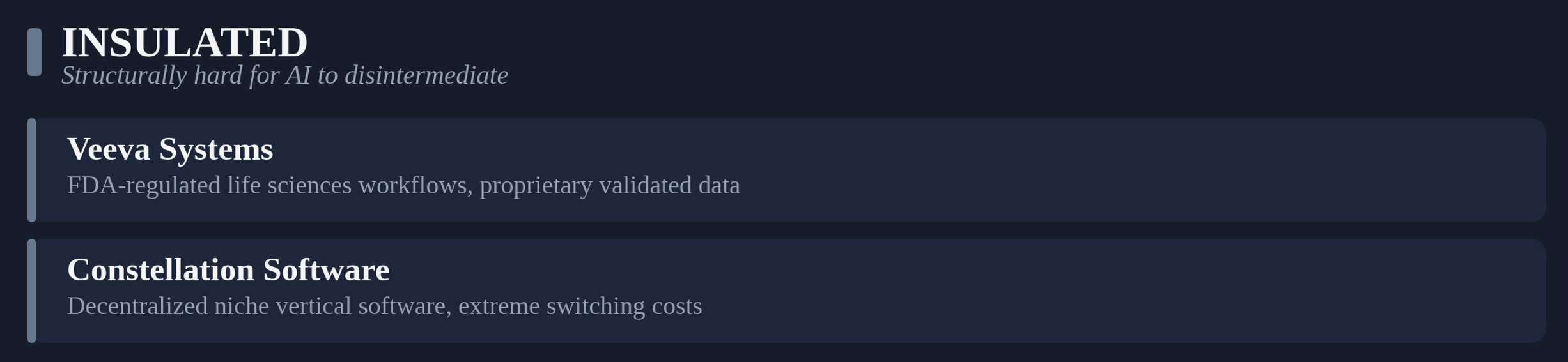
Veeva Systems
Veeva sells cloud software to life sciences companies for FDA-regulated processes: clinical trials, drug safety, regulatory submissions.
That’s about as far from a “thin AI wrapper” as software gets.
Fiscal 2026 revenue came in at $3.2 billion, up 16%, with subscription revenue up 17%, and the company still put up double-digit growth while building agentic tools (Veeva Falcon, launching for early access in November 2026) directly into those regulated workflows rather than trying to replace them.
Worth noting: Veeva wasn’t immune to the sector-wide fear either. Shares were down about 16% year-to-date heading into its Q4 report before jumping more than 10% on the earnings beat.
That’s the pattern this whole article is about: good business, dragged down by a generic narrative, snapping back once the numbers forced a correction.
Run it through the framework and the reason is obvious: regulated buyer, proprietary validated data, deep workflow lock-in. None of that goes away because a model gets smarter.
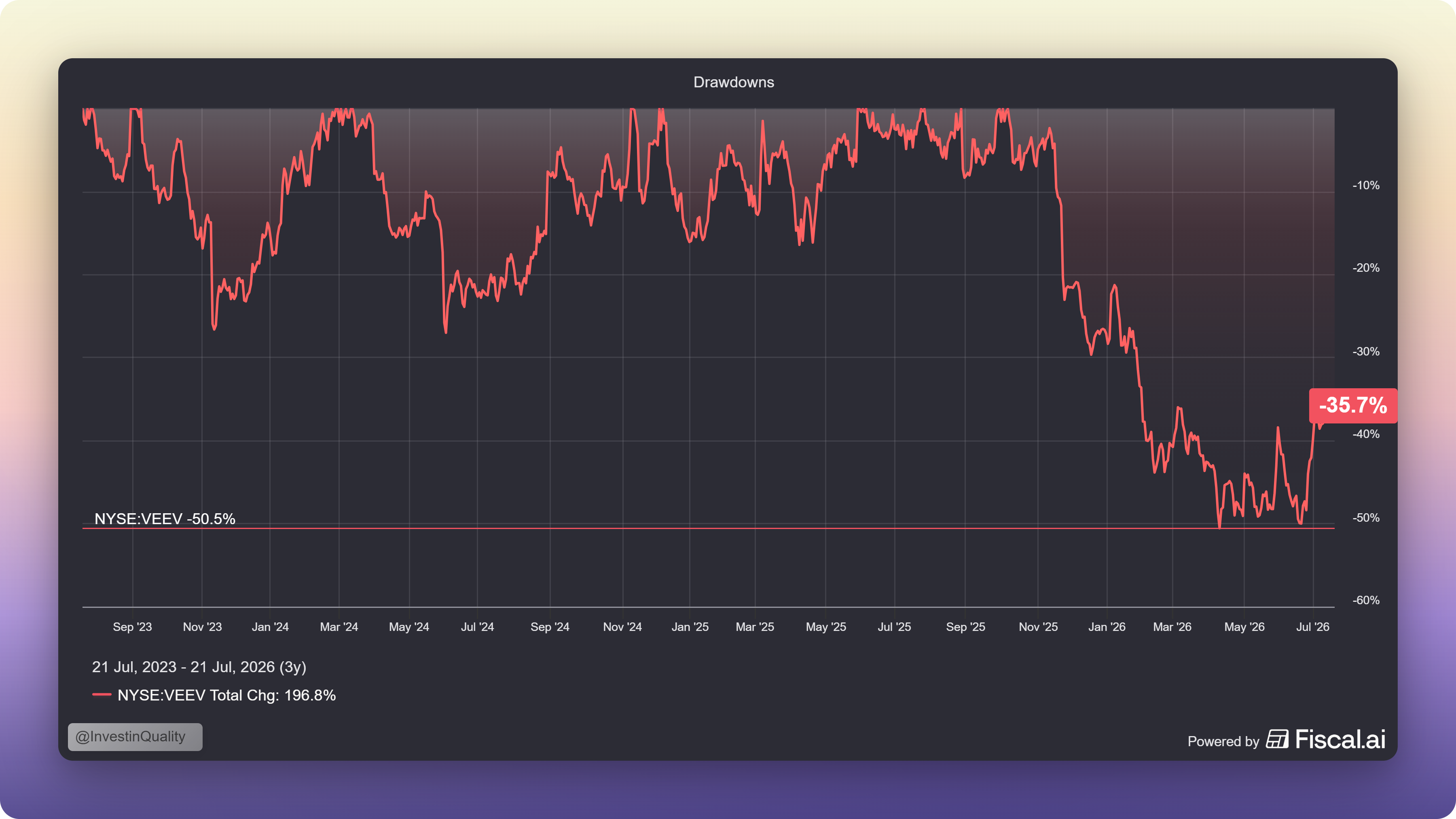
Veeva is down 35.7% from its 2025 all time highs:
Constellation Software
Constellation is close to the opposite of a thin AI wrapper by design.
It’s a collection of hundreds of decentralized, deeply niche vertical market software businesses, the kind of software that runs a specific municipal utility’s billing system or a specific type of clinic’s scheduling software.
These products are often the single system of record for a small, specific customer base that has no appetite to switch, and often no real alternative to switch to.
That’s precisely the profile the framework says should survive: the moat isn’t the software’s cleverness, it’s decades of embedded, mission-critical use inside a workflow with high switching costs and a narrow, non-generic problem to solve.
A general-purpose AI model doesn’t casually rebuild hundreds of tiny, deeply specific vertical systems, and Constellation’s capital allocation discipline means it can keep buying more of them regardless of the AI narrative swirling around big-cap SaaS.
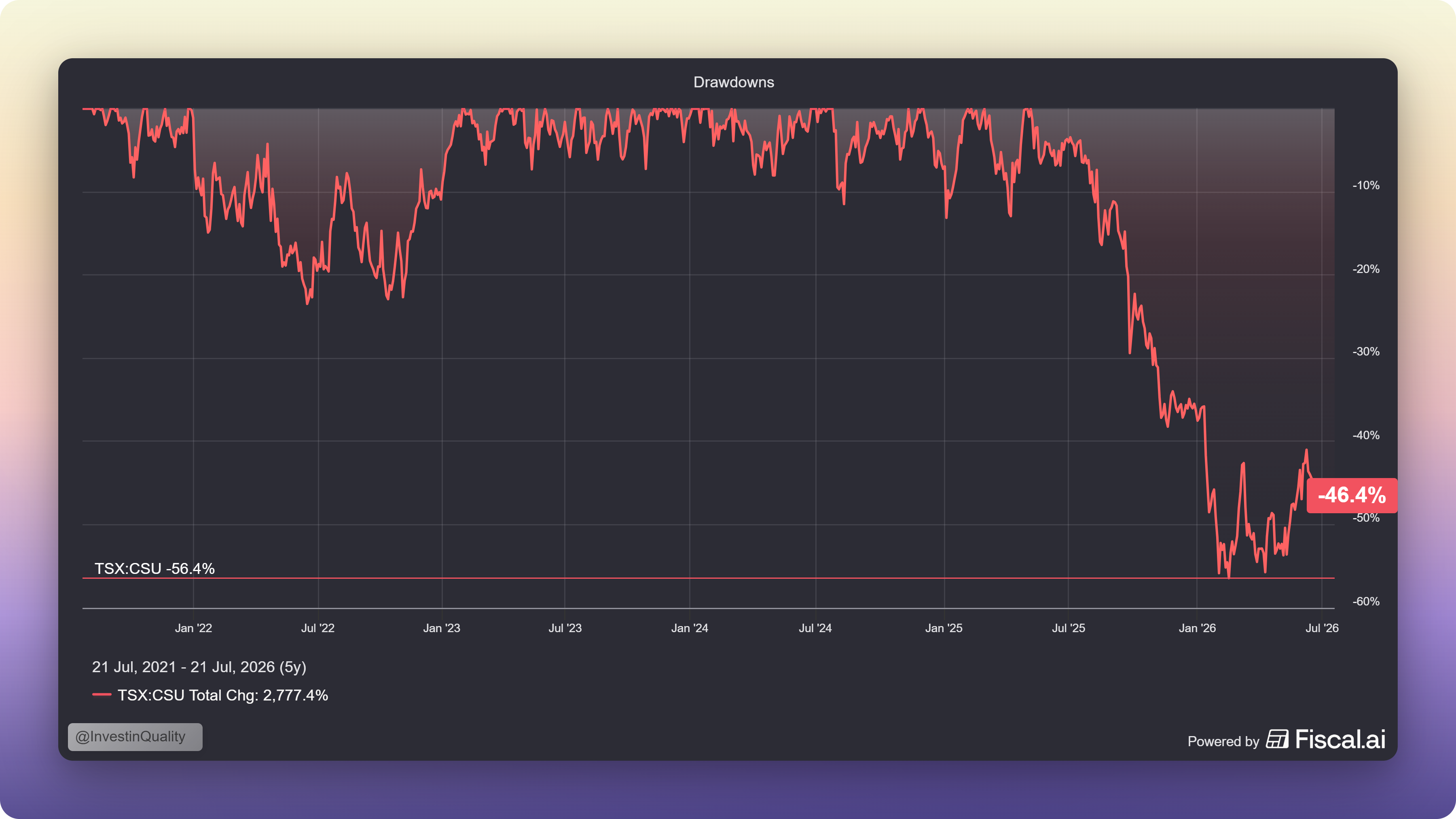
Despite the robustness of Constellation’s portfolio, the stock is down -46.4% from its all time highs:
5 More companies that are insulated:
Roper Technologies
Tyler Technologies
Guidewire Software
SS&C Technologies
Fair Isaac (FICO)
Bucket 3: the gainers (the bucket that actually matters)
This is the group I think is most mispriced. These are companies where AI is a demonstrated tailwind, not a threat, but where sector-wide fear has still pulled the stock down.
Salesforce: same panic, opposite data
Salesforce and Workday got hit by the identical narrative, the “Seat-Count Crisis,” at the same time.
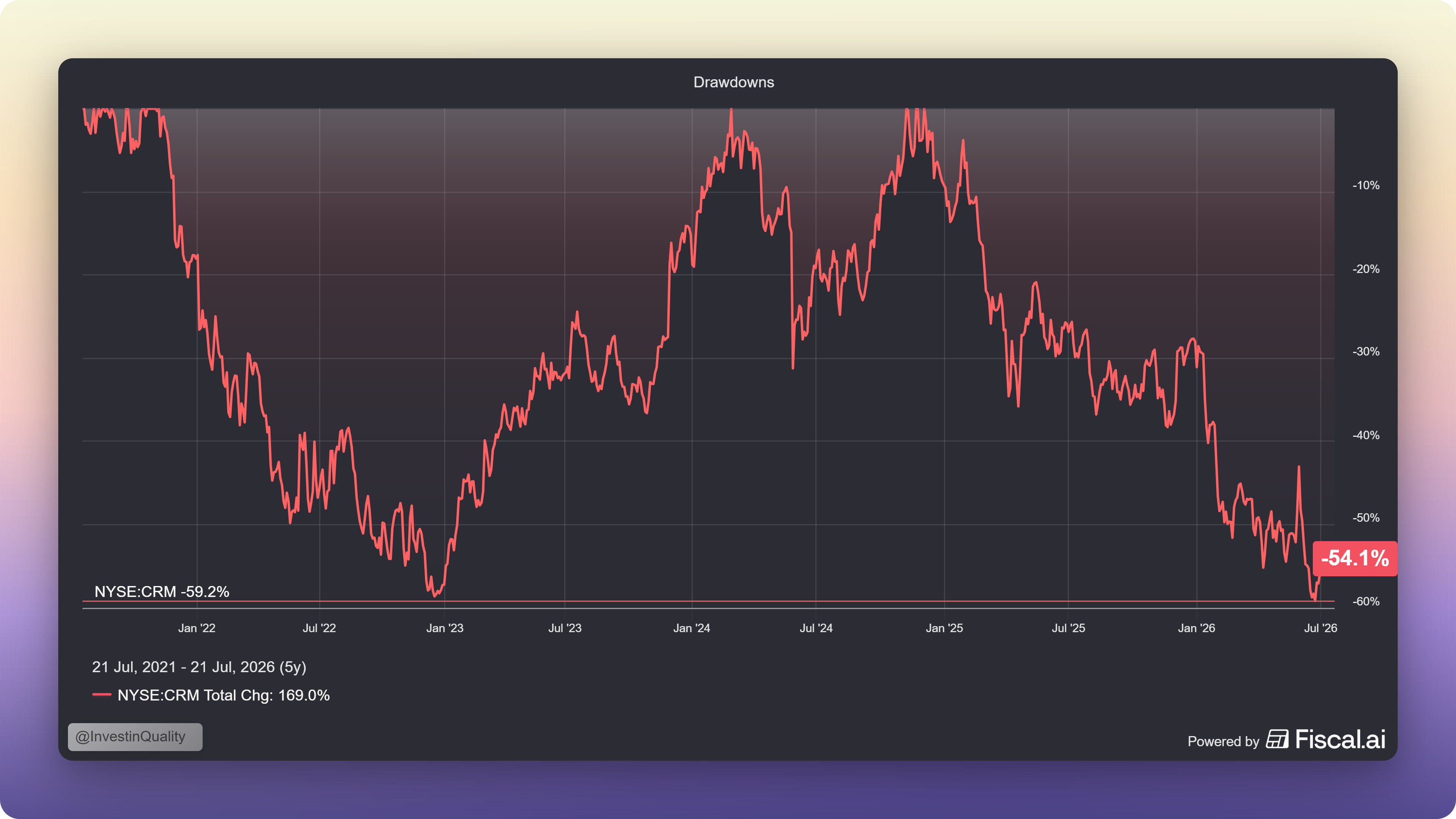
Salesforce shares fell as much as 54.1% from 2025 highs:
But look at what actually happened inside the business instead of the narrative around it.
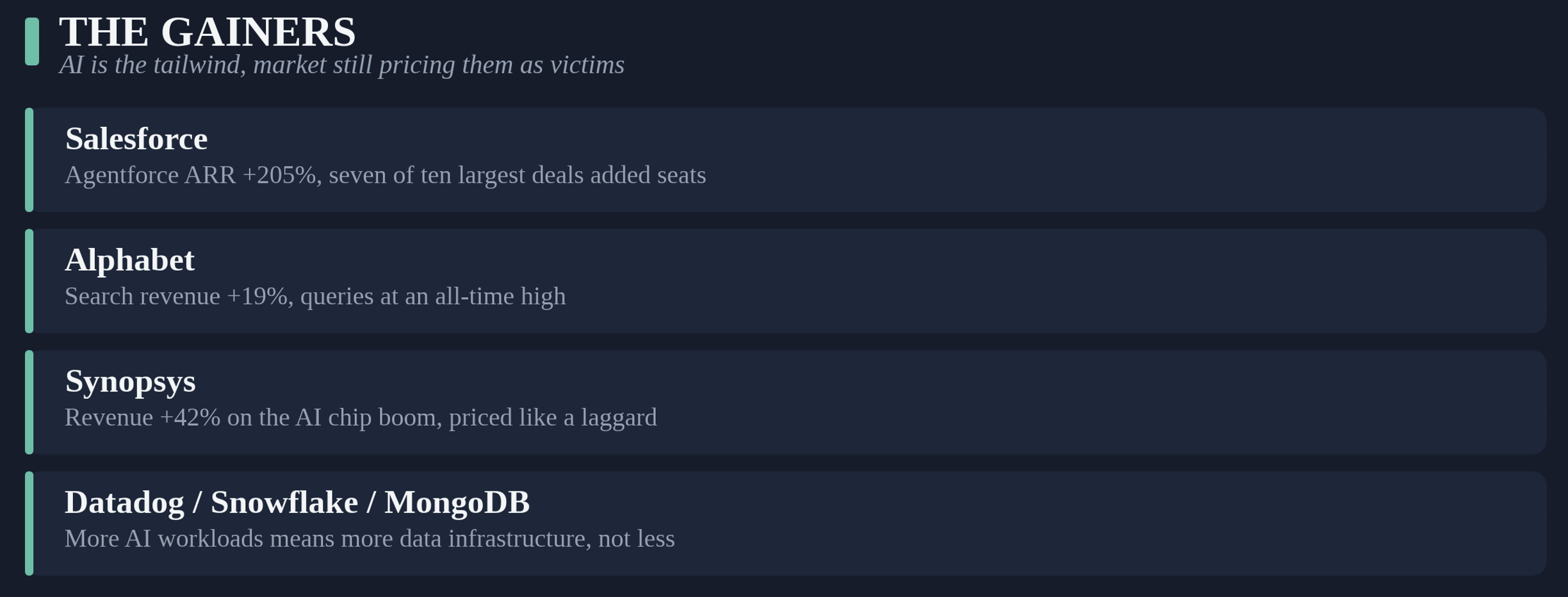
Agentforce, Salesforce’s AI agent platform, grew annual recurring revenue from $800 million to $1.2 billion in a single quarter, up 205% year over year.
And here’s the detail that directly contradicts the bear case: seven of Salesforce’s ten largest deals in that quarter added seats.
Management is explicitly repricing around usage instead of defending the old seat model, shifting toward metered, consumption-based billing for agentic work through a platform called m3ter.
The stock was trading at 12x forward earnings with 13% revenue growth and expanding margins as of this writing. This is a valuation that assumes the bear case is already true.
Same fear, same sector, and different underlying data than Workday. That’s the kind of distinction the four-question framework is built to catch, and exactly why treating “seat-based SaaS” as one undifferentiated bucket is a mistake.
Alphabet: the “AI kills Google” thesis, disproven by Google’s own numbers
Most investors have most likely already forgotten that GOOGL 0.00%↑ stock was trading sub $150 in April of 2025 (Now trading at $354).
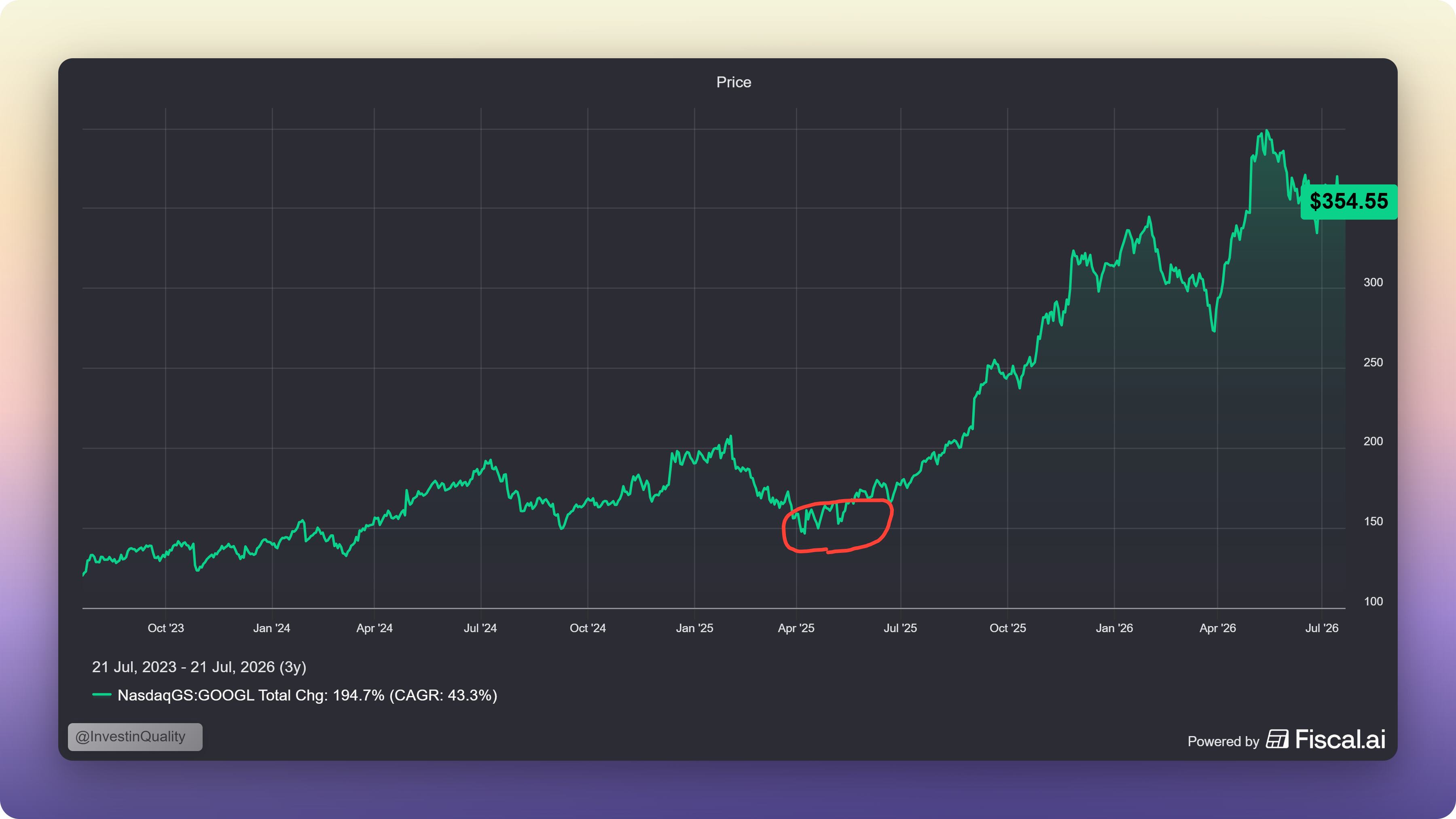
The bear case and narrative on Alphabet was: “ChatGPT kills Search”.
This narrative had slowly built since November 2022, but in 2025 the narrative hit the stock price hard.
This is maybe the purest example of sector-wide fear versus company-specific reality.
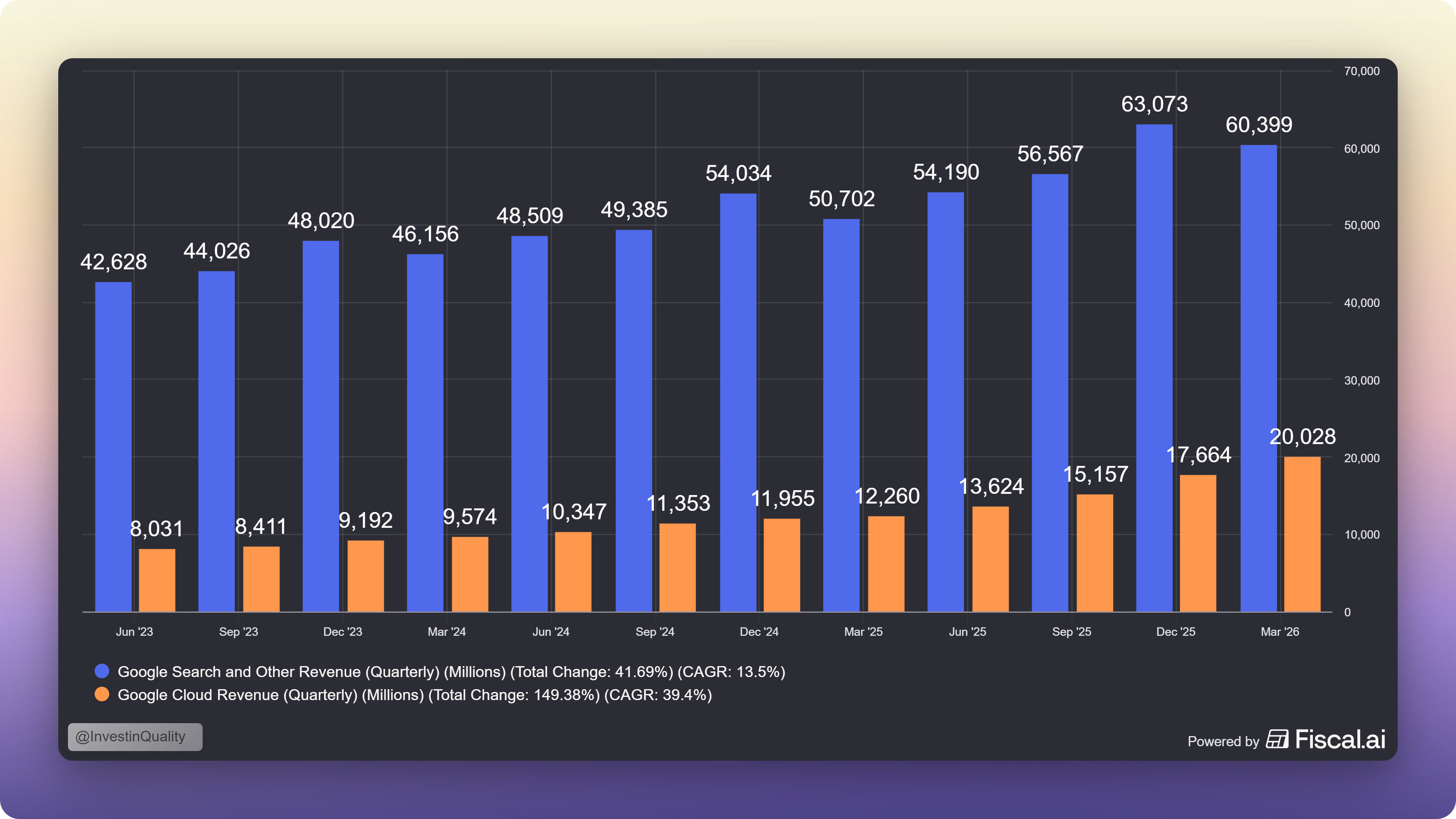
The Q1 2026 numbers say the opposite happened: Google Search revenue hit $60.4 billion, up 19% year over year, with management citing search queries at an all-time high.
Google Cloud grew 63% to $20 billion, with a contracted backlog that’s nearly doubled to over $460 billion.
Alphabet still has real risks worth mentioning: capital expenditure is enormous (2026 guidance of $180-190 billion), free cash flow has compressed sharply during the build-out, and the AI model race with OpenAI and Anthropic is genuinely competitive, not a foregone conclusion.
But the specific mechanism the market feared, generative AI directly cannibalizing search traffic and ad revenue, has not shown up in the data.
Google folded AI Overviews directly into the product instead of losing users to a separate one, and it’s monetizing at a similar rate to classic search.
Synopsys: benefiting from the boom, priced like a casualty
Here’s a genuinely odd one in my opinion.
Synopsys, half of the EDA software duopoly (alongside Cadence) that every advanced chip design runs through before reaching a fab, reported Q2 fiscal 2026 revenue of $2.28 billion, up 42% year over year, directly riding the AI chip design boom.
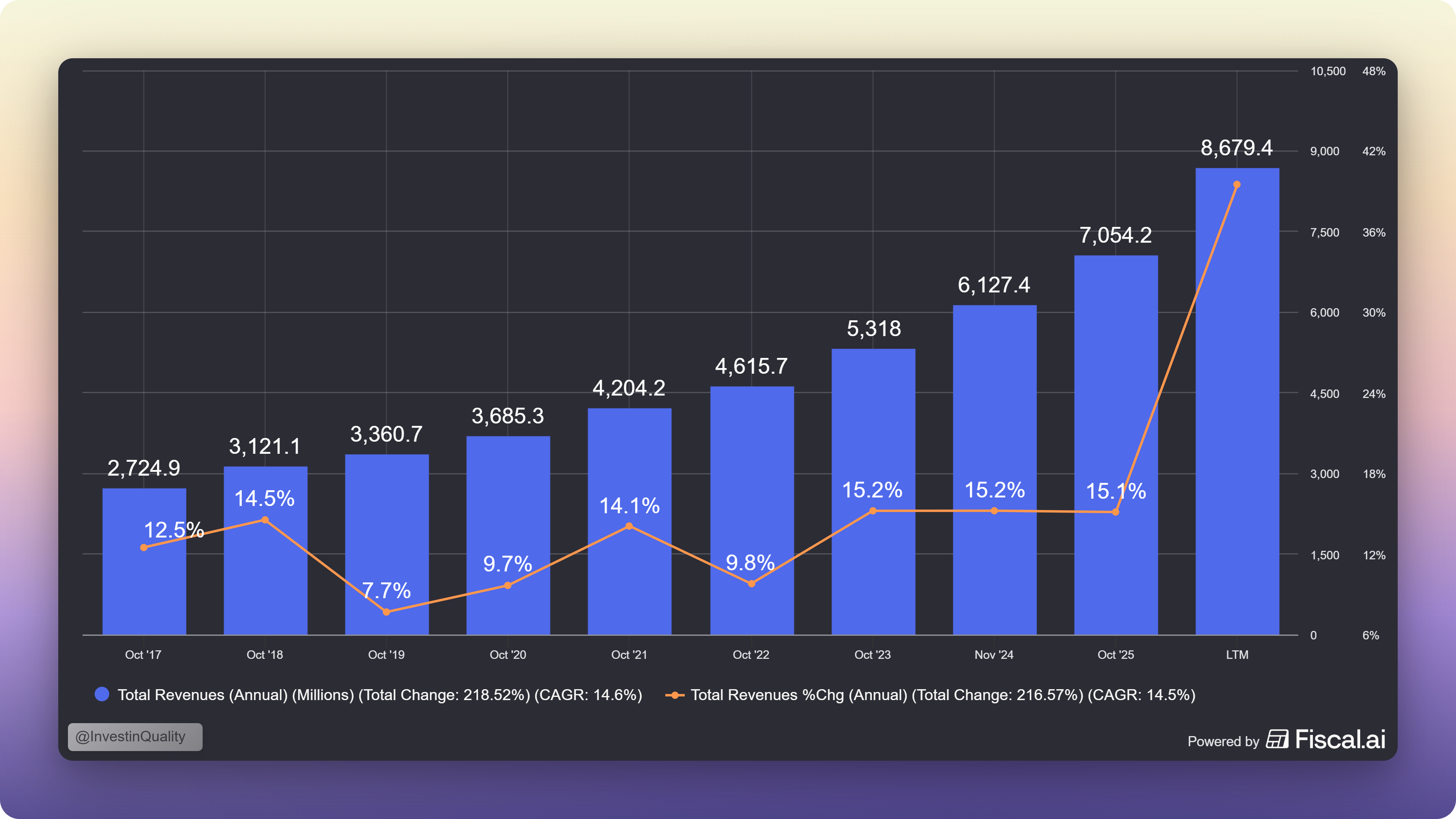
And the stock was still down roughly 20.8% year-to-date and 41% from its all time highs.
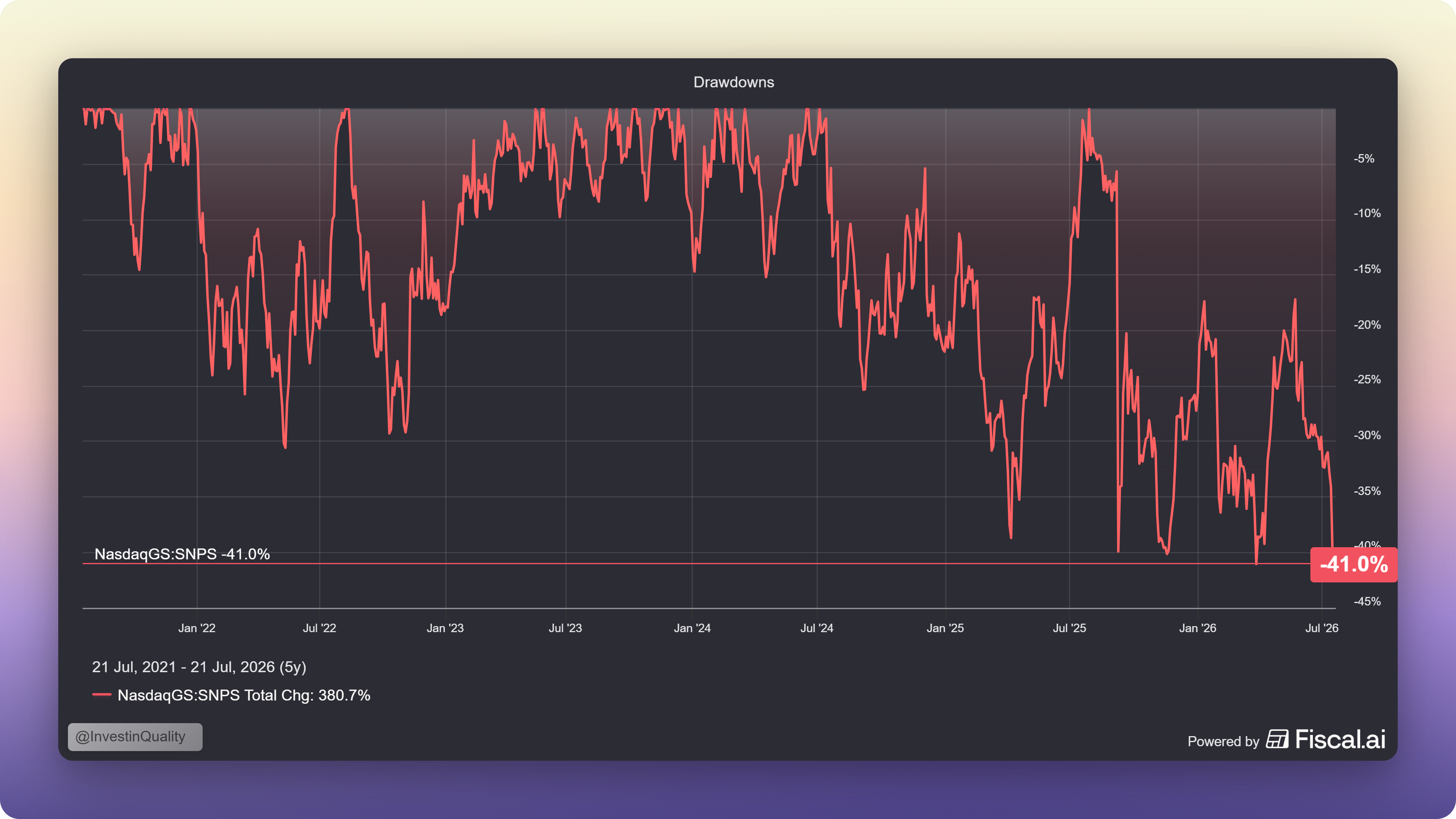
At the same time Cadence, its closest peer with a similar growth story, was up around 19-21%.
Some of that gap is company-specific, Synopsys is digesting a roughly $35 billion Ansys acquisition, which creates real integration risk worth taking seriously rather than dismissing.
But a chunk of the underperformance looks like collateral damage from the broader “AI kills software” narrative bleeding into a company whose entire business exists because of the AI chip buildout.
Switching costs in EDA are about as extreme as software gets: engineers spend years learning a specific tool flow, and Synopsys and Cadence together dominate the market almost by default.
The data infrastructure “Fab Five”
Bank of America has grouped Snowflake, Datadog, MongoDB, JFrog, and Twilio as a basket that’s up roughly 30% on average in 2026, while the broader software sector ETF (IGV) was down about 12% over the same stretch.
The logic is simple: every AI model in production needs somewhere to store data, something to monitor performance and cost, and infrastructure to run on, and none of that shrinks when AI gets more capable, it grows.
Datadog is the clearest example: Q1 2026 revenue crossed $1 billion for the first time, up 32% year over year, with AI-linked revenue now over 10% of the total and growing faster than 100% annually.
The stock jumped over 30% in a single session on that report and pulled Snowflake and MongoDB up alongside it.
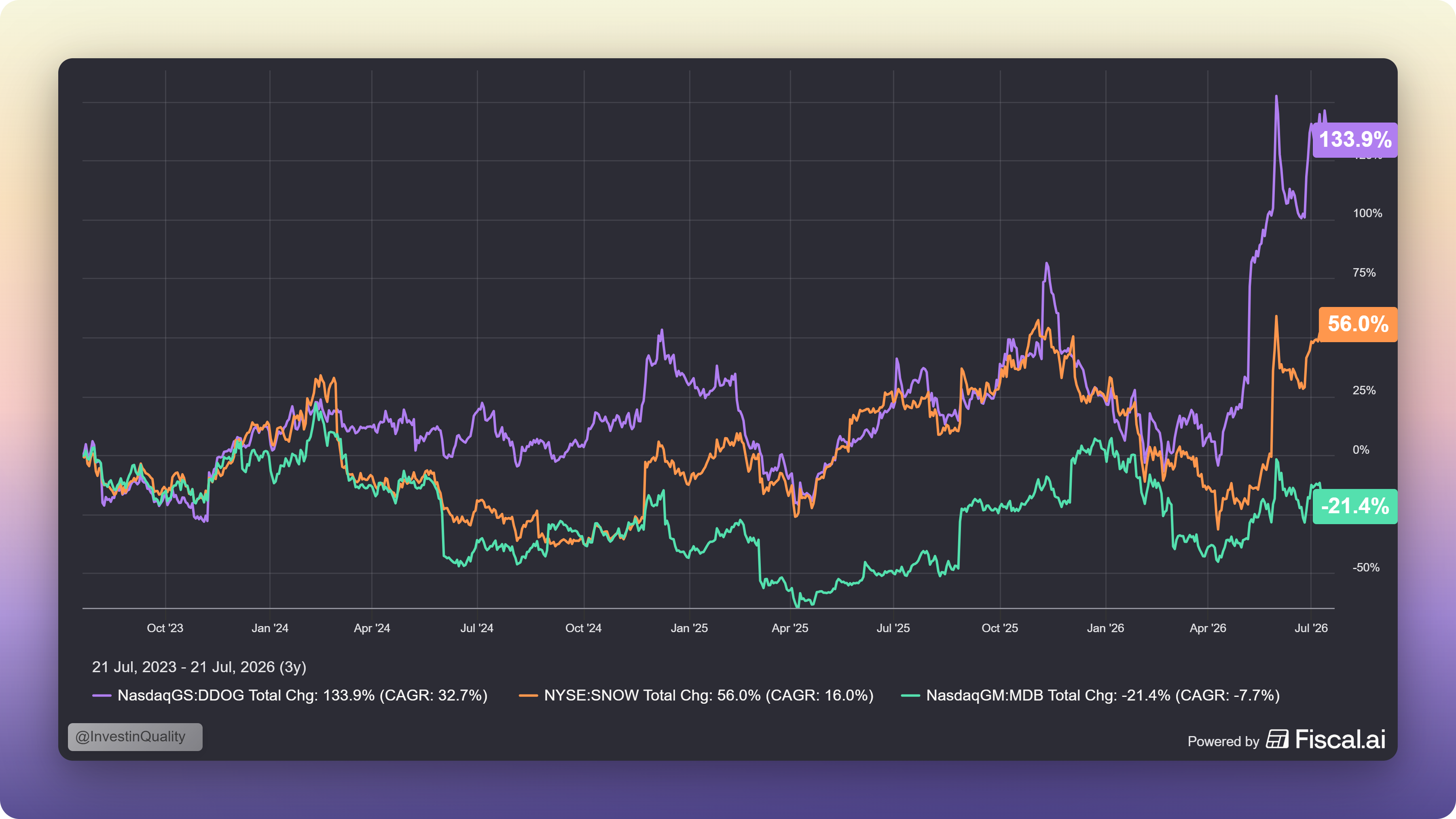
Snowflake’s product revenue grew 30% in its most recent quarter, directly tied to the volume of data enterprises are processing for AI workloads.
Worth being honest about the other side: this group isn’t cheap. Snowflake in particular has traded at 120-140 times forward earnings at various points this year, which leaves very little room for a slowdown in enterprise data spending.
But the mechanism: more AI usage requiring more data infrastructure, is the opposite of the seat-cannibalization risk facing Chegg or Globant.
5 More companies that are AI gainers:
Palo Alto Networks
Arista Networks
CrowdStrike
ServiceNow
Oracle
How to run this yourself
Before buying (or avoiding) any SaaS name on an AI narrative, ask:
Does the moat live in the software itself, or in the data, workflow, and switching costs around it?
Is revenue tied to headcount, or to usage and outcomes?
Would a generic AI model actually replace what this company sells, or does it need this company’s specific data and workflow to be useful at all?
Is the stock down because the business is actually impaired, or because it shares a sector label with companies that are?
That last question is the one the market keeps ignoring.
The takeaway
AI disruption in software is real, Chegg proved that beyond argument, and the IT-services squeeze on Globant and EPAM is a live, structural story happening now.
But the market is currently pricing entire categories, seat-based software, anything labeled “SaaS,” as if they share Chegg’s problem. But many don’t.
The actual opportunity isn’t avoiding AI risk, it’s owning the companies where AI is making the business stronger while the stock still trades like it’s a victim.
Salesforce with Agentforce actually adding seats, Alphabet with search revenue accelerating, Synopsys riding a chip design boom while priced like a laggard, a data infrastructure basket growing because AI needs somewhere to run.
The panic is still real, but identifying the quality SaaS businesses that have sold off is where the opportunity lies in the current market.
I hope you enjoyed the article.
Ready to take the next step? Here’s how I can help you grow your investing journey:
Go Premium — Unlock exclusive content and follow our market-beating Quality Growth portfolio. Learn more here.
Essentials of Quality Growth — Join over 300 investors who have built winning portfolios with this step-by-step guide to identifying top-quality compounders. Get the guide.
Free Valuation Cheat Sheet — Discover a simple, reliable way to value businesses and set your margin of safety. Download now.
Free Guide: How to Identify a Compounder — Learn the key traits of companies worth holding for the long term. Access it here.
Free Guide: How to Analyze Financial Statements — Master reading balance sheets, income statements, and cash flows. Start learning.
Get Featured — Promote yourself to over 24,000 active stock market investors with a 42% open rate. Reach out: investinassets20@gmail.com