
Terry Smith's Radical Shift in Strategy 📈
13 sales, and 12 new positions, a new direction for Fundsmith

Hi, investor 👋
Terry Smith, the legendary quality investor, just made the biggest strategy shift of his career.
For 20 years, his playbook was simple: buy great companies, pay a fair price, hold forever.
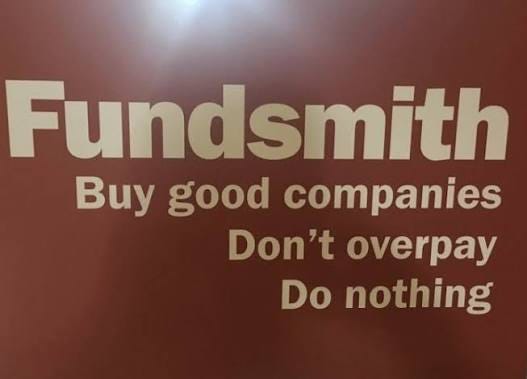
That approach made him one of the best fund managers in the world.
It’s also the approach he just significantly broke from.
The shift comes after five straight years of underperformance, with Fundsmith now barely ahead of its benchmark since inception, despite being miles ahead of it at points in the past.
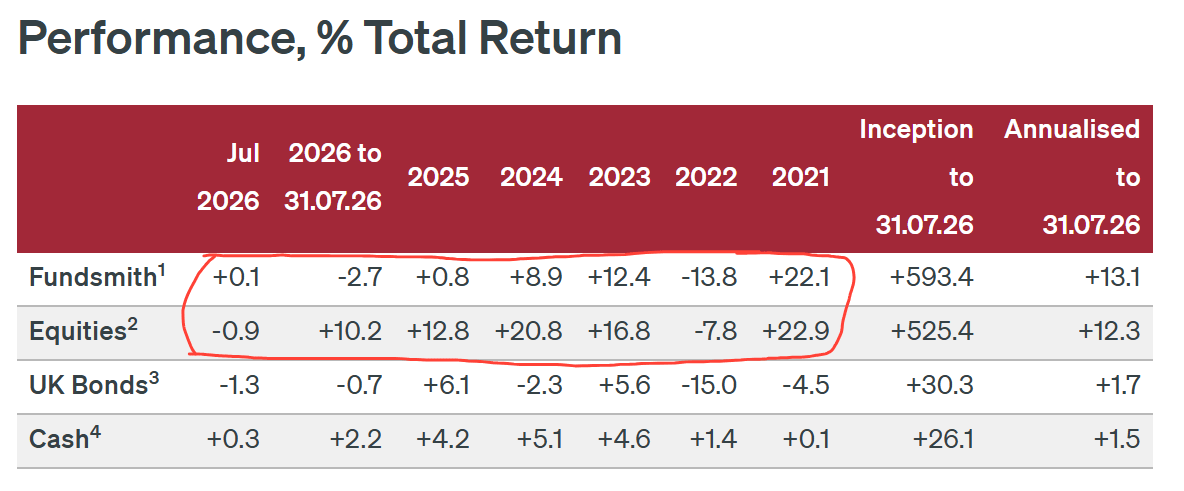
Many investors are saying Terry has lost the plot. I think he’s finally fixing the one thing that made him great in the first place, and then let him down.
What made Terry Smith great
I’ve followed Terry’s portfolio for years. What actually drove his best returns wasn’t just “buy quality.” It was buying quality at a discount.
At the start of his best-performing stretch, his holdings had a meaningfully higher free cash flow yield than the index.
That gap closed over time, and eventually his portfolio got more expensive than the market.
For a while, that didn’t matter, because he was getting paid twice: multiple expansion and earnings growth, compounding together. That combination is what built the legend (The dual engine of compounding).
But in recent years, Terry got complacent and kept holding expensive, slow-growing “quality” names well past the point where the valuation made sense. Look at his top holdings before this shift:
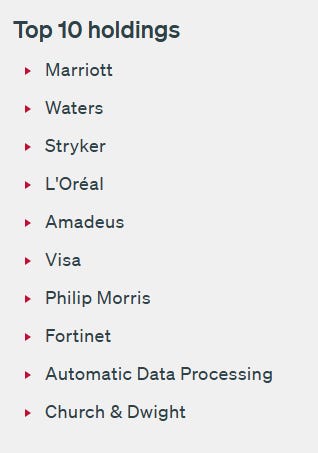
Marriott International (his top holding):
38.6x trailing earnings
30.9x forward
2.9% FCF yield
11.4% expected growth
ROIC of just 12.8%
From 2022 to TTM 2026, the PE expanded 19.64% annually while EPS only grew 8.03%. Almost all the stock’s return came from multiple expansion.
Waters Corp.
46.8x trailing PE
24.6x forward
11.1% expected growth
The stock hasn’t moved in five years. The PE expanded from ~32x to 46.8x while EPS actually contracted 7.4% annually.
Even a strong future (12% EPS growth, premium multiple held) only gets you to a 12% return, and that’s the good case.
Stryker Corp.
36.9x trailing PE
20.3x forward
10.8% expected growth
9.5% ROIC
The same story with Stryker Corp., expensive relative to growth.
These are great businesses. But from these valuations, there’s no realistic path to the ~15% annual returns Fundsmith investors have come to expect. You’re much more likely to get multiple contraction than expansion from here.
So Terry appears to have concluded that his strategy needed to evolve.
We’ve seen Buffett do the same thing when he bought Apple in 2016, breaking his own rule against high-tech businesses outside his circle of competence.
It became his most profitable trade ever.
Terry is making a similar bet: shift toward businesses actually positioned to grow, even if that means paying up and taking on more risk.
Terry is just doing it in a more dramatic fashion than Buffett.
What he sold: expensive stalwarts with fading growth
The pattern across nearly every sale is the same: good business, bad combination of price and growth.
Atlas Copco – Organic growth has been weak for two years, not enough to justify a sub-3% FCF yield after the stock’s sharp run-up.
Coloplast – Organic growth slowed from a long-term average of 8% to 6%, alongside a couple of high-profile acquisition missteps.
EssilorLuxottica – Lower margins on smart glasses forced management to abandon its long-term profit targets. Still an interesting business riding the wearables trend, but competition is intensifying.
Intuit – Bought back only recently, sold again over how management handled the poor Mailchimp acquisition, including reporting results ex-Mailchimp, which both confirms how bad the deal was and raises concerns about denial. Terry prefers Sage for similar exposure without the Mailchimp baggage.
LVMH – China, its key market, is unlikely to recover until the property market does. Family succession is also a growing concern.
Magnum Ice Cream Co. – Too small and illiquid to build a meaningful position, and expensive relative to its growth.
Mettler-Toledo – Underlying growth of just 1% this year doesn’t justify its traditionally premium valuation.
Nike – The turnaround under new CEO Elliott Hill is taking longer than expected, with China and Converse still dragging.
Novo Nordisk – A market-leading position in the biggest drug discovery in decades, turned into an investment disaster. Terry defended this position publicly multiple times before finally deciding capital was better allocated elsewhere. In hindsight, the ideal exit was earlier, when the problems first surfaced, but a recovery before 2027 looks unlikely and this isn’t an unreasonable sale. Fundsmith gave up nearly all its gains from the position first built around 2017–2019.
Otis – Growth in maintenance and modernization hasn’t offset the decline in new construction demand from China.
Unilever – New CEO Hein Schumacher initially impressed by ruling out near-term M&A. He was fired after 18 months and replaced by CFO Fernando Fernandes, whose appointment was quickly followed by spinning off the ice cream business and a deal to transfer the food business to McCormick, despite earlier assurances there’d be no further disposals. It has the fingerprints of activist board member Nelson Peltz, whose track record with corporate restructuring Terry doesn’t trust. McCormick’s ROIC has consistently run in the single digits, and the deal structure doesn’t even give shareholders a vote.
Wolters Kluwer – Still a business Terry thinks AI won’t disrupt much, but he sees better value elsewhere in the post-”SaaSpocalypse” space, namely Sage and Veeva Systems, both offering higher growth and/or lower valuations.
Zoetis – Management hasn’t responded effectively to new generic competition, and can’t articulate a clear plan. Cheap, but growth is slowing and the competitive position is weakening.
None of these are bad sales on their own.
What’s striking is that Terry bought several of these names recently, which is part of why the reversal feels so abrupt.
It reminds me of Buffett’s willingness to admit a mistake and move on fast. I relate to this one personally. I hold onto losers far longer than I should too.
Follow our real-money Quality Growth Portfolio, every buy, sell, and position size, with same-day alerts:
Terry bought faster growth & higher risk
This is where the real story is.
Terry is buying businesses he’s never owned before, in sectors he’s historically avoided.
Industrials
GE Vernova builds and services the gas turbines and grid equipment that power roughly a third of the world’s electricity. The moat comes from scale and switching costs: once its turbines are installed, customers are locked into decades of high-margin, inflation-protected service contracts, and unlike elevators, this equipment can’t be serviced by third parties. Growth is tied to upgrading aging power grids and to “behind-the-meter” generation for AI data centers, backed by a $163bn order book, 4x 2025 revenue. GE Vernova also leads small modular nuclear reactors in the Western world, with its first commercial deployment expected in Canada by 2030. ROIC is ~20% and rising fast, FCF yield 2.6%. The stock is up 659.5% in a little over two years.
Legrand makes the unglamorous physical infrastructure inside buildings: wiring, sockets, busways. Its edge is an entrenched distribution network and electrician loyalty, professionals who won’t risk their reputation on unfamiliar components. It holds close to 20% global market share in wiring devices. Growth comes from energy-efficient smart buildings and data center power distribution, a market expected to triple in the US. ROIC is in the low 20s, FCF yield 4.4%, trading at 28.1x trailing / 22.4x forward earnings with 10.1% expected growth. Not a fast grower, but the data center exposure is likely the draw.
Nextpower makes the tracking systems and software that let utility-scale solar panels follow the sun, boosting energy yield 20–30% over fixed panels. The moat combines a low-fixed-cost outsourced manufacturing model with proprietary software that’s hard to switch away from once installed. It acquired battery maker Prevalon Energy for $365m in May 2026 to expand into data centers. ROIC is ~50%, FCF yield 3.2%, five-year revenue CAGR of 27.6%. Gross margins expanded from 10% in 2022 to 32.6% LTM, and ROIC from 9.2% to 31.5% over the same period.
Terry has historically stuck to consumer products, healthcare, and technology, so three industrials purchases in one shareholder letter is a real departure, even accounting for the data center angle on Legrand.
Uber connects riders and drivers through a two-sided network effect that gets stronger and harder to disrupt as it scales. Most of its early competitors, Karhoo, Sidecar, Juno, Fasten, Hailo, are gone. Cash from operations went from -$4.3bn in 2019 to -$445m in 2021 (its last negative year) to $3.6bn in 2023 and over $10bn in 2025. Uber now coordinates roughly 42 million trips and delivery orders a day. Future growth includes grocery and package delivery, plus eventual integration of autonomous vehicles, where Uber’s distribution and licensing likely make it a partner rather than a threat to players like Tesla and Waymo. ROIC is in the mid-20s, FCF yield 7.4%.
I like this one a lot. We wrote a deep dive on Uber a few months back with almost this exact thesis, so either Terry reads Invest in Quality, or great businesses just look the same to anyone doing the work.
Financials
Mastercard: a payments network with a textbook network effect, more users force more merchant acceptance, which makes replicating it nearly impossible for a new entrant. Roughly 1.4bn adults globally remain unbanked, and 46% of global transactions are still cash, with B2B payments representing 85% of total payment value, still largely untapped. Fundsmith now owns both Visa and Mastercard, giving it over 6% payments exposure without concentrating single-stock risk. ROIC exceeds 75%, FCF yield 4.5%, and the stock is trading at its best valuation in a long time.
Health care
Veeva Systems builds cloud software that tracks a drug’s entire lifecycle, from clinical trials through manufacturing and sales, for the pharma and life sciences industry. Its moat is extremely high switching costs: once a drug company builds Veeva into its regulatory and trial infrastructure, ripping it out risks halting trials or manufacturing entirely. Veeva holds roughly 80% market share in pharma CRM software. Headline ROIC is ~15%, but that’s dragged down by a large cash balance; excluding cash it’s well over 100%. FCF yield is 5.7%. The stock is down 45.3% from its highs on “AI will eat software” fears, but Veeva sits in a highly regulated market where getting the software wrong is far more costly than any savings from switching, which limits AI disruption risk. Net debt is -$7.2bn and expected EPS growth is 21.5%. This looks like a legitimate rebound candidate.
Technology
AppLovin provides the AI ad-matching engine (AXON) behind mobile app advertising, the unskippable ad between levels in a game like Candy Crush. AXON’s network effect makes it hard for either advertisers or app developers to leave once they’re matched effectively, and it can likely grow revenue 20% annually just from improving targeting. AppLovin serves over 1bn daily active users and generates more ad revenue than Snap, Pinterest, Reddit, and X combined. Unlike Alphabet or Meta, which charge per impression or click, AppLovin takes a cut of the transaction itself, so it earns more from high-value purchases than from a $5 game download. ROIC exceeds 100%, FCF yield 3.6%, gross margins 88.4%, five-year average ROIC 32.3%, trading at 35.6x trailing / 23.9x forward earnings with ~30% expected EPS growth. The moat here is narrower than Terry’s usual holdings, but the fundamentals are excellent.
Sage: swapped in for Intuit, Sage competes directly in accounting software with less reliance on stock-based comp, a lower valuation, and none of Intuit’s history of value-destroying acquisitions. ROIC 18%, FCF yield 6.0%, 15.4x forward PE, 13.6% expected EPS growth. A fair-value business bought for good reasons.
TSMC manufactures roughly 90% of the world’s most advanced semiconductors, the ones inside chips designed by Apple, Broadcom, and Nvidia. Its moat is a technological lead protected by a capital barrier: it costs roughly $20bn to build one advanced fab. ROIC 33%, FCF yield 2.7%, 19.4x forward PE, ~30% expected EPS growth. What’s notable isn’t the business quality, it’s that Terry is now willing to underwrite Taiwan geopolitical risk, something he’s historically avoided entirely.
Consumer discretionary
The TJX Companies, parent of TJ Maxx and Marshalls, runs an agile off-price supply chain built on decades-long relationships with premium brands, buying excess inventory at steep discounts through a network of 1,400+ buyers sourcing from 21,000 vendors. Growth comes from store expansion and share gains from department stores. ROIC 33%, FCF yield 3.1%, but at a 30.2x trailing / 29.4x forward PE against only ~8.6% expected growth, this one looks like a step back toward the expensive-and-slow pattern Terry is supposedly moving away from.
Yum! Brands, parent of KFC, Taco Bell, and Pizza Hut (which it’s finally divesting after it dragged on results), opens a new restaurant somewhere in the world roughly every two hours, every day of the year. Growth depends on continued franchise expansion in emerging markets and better digital ordering, with near-term upside in a currently underperforming US KFC business and Taco Bell’s international expansion. ROIC 50%, FCF yield 4.0%, 23.8x trailing / 21.6x forward PE, 11.7% expected growth. Solid, capital-light, high-ROIC business. Not a screaming buy, but a reasonable one.
Communication services
Netflix, the pioneer of subscription streaming, funds a $17bn+ annual content budget that smaller rivals can’t match without losing money, and now accounts for nearly 8% of all US television screen time, more than any single broadcast network. Its ad-supported tier has 250 million monthly active users (45% US-based), and cracking down on password sharing added 41 million subscribers after 2024. It’s also pushing into live sports, including NFL games on Christmas Day and high-profile boxing events. Rivals like Hulu, Discovery+, Tubi, and HBO Max have largely failed or lost share, strengthening Netflix’s position and creating room to win back lapsed subscribers. ROIC exceeds 30%, FCF yield 3.8%, trading at 21.7x trailing / 20x forward earnings with 20.9% expected growth, despite the stock compounding at only 6% CAGR over the past five years.
This is one of the stronger purchases in the letter. Clear market leadership, obvious growth drivers, real pricing power, and a valuation that hasn’t run away from the fundamentals.
Has Terry lost his mind?
I don’t think so, and here’s my honest read on why he’s doing this now.
Terry has repeatedly called both index investing and momentum investing a bubble.
Now he’s tilting into the exact style he was criticizing months ago. That looks bad on the surface. But Fundsmith’s assets under management have fallen from a peak of £29 billion to roughly £12.2 billion, a 58% decline, largely lost to index funds, his biggest competitor.
When you’re bleeding AUM and your investing style isn’t rewarded by the market, you either stick to your guns and keep shrinking, or you adapt.
Unlike Buffett at Berkshire, Terry doesn’t manage permanent capital.
Underperformance triggers real redemptions, and Fundsmith is a business as much as a fund. When AUM falls, the business suffers.
I keep coming back to Ray Dalio’s line:
“Embrace reality and deal with it.”
Blaming index funds and momentum investors for his underperformance would have been sticking his head in the sand.
Instead, Terry sold expensive, slow-growing stalwarts and bought faster-growing businesses with both fundamental and price momentum.
That’s dealing with reality, even if it comes years later than it should have.
Shareholder returns ultimately break down into two things: multiple expansion and earnings growth.
To maximize your odds, you want to buy at a reasonable multiple with real earnings growth ahead of you.
What Terry has done here is tilt that equation back in his favor, at the cost of taking on more risk than Fundsmith investors are used to.
The key takeaway
Terry Smith isn’t abandoning quality investing, he’s fixing the mistake that undermined it: holding expensive, slow-growing “quality” stalwarts for too long.
Whether this was the strategy he’d have chosen without the AUM pressure is a fair question, but the direction, cheaper entry points plus faster growth, is the right instinct.
I’m more interested in Fundsmith today than I’ve been in years, and I’ll be watching how this plays out over the next five.
Ready to take the next step? Here’s how I can help you grow your investing journey:
Go Premium — Unlock exclusive content and follow our market-beating Quality Growth portfolio. Learn more here.
Essentials of Quality Growth — Join over 300 investors who have built winning portfolios with this step-by-step guide to identifying top-quality compounders. Get the guide.
Free Valuation Cheat Sheet — Discover a simple, reliable way to value businesses and set your margin of safety. Download now.
Free Guide: How to Identify a Compounder — Learn the key traits of companies worth holding for the long term. Access it here.
Free Guide: How to Analyze Financial Statements — Master reading balance sheets, income statements, and cash flows. Start learning.
Get Featured — Promote yourself to over 24,000 active stock market investors with a 42% open rate. Reach out: investinassets20@gmail.com